The Best Stellenbosch Wine Farms: 14 Estates Ranked for 2026
More than 150 wine farms ring the town, but a good day only fits four or five. These are the Stellenbosch estates that keep winning awards, pour the wines the region is known for, and actually welcome visitors.
Short answer
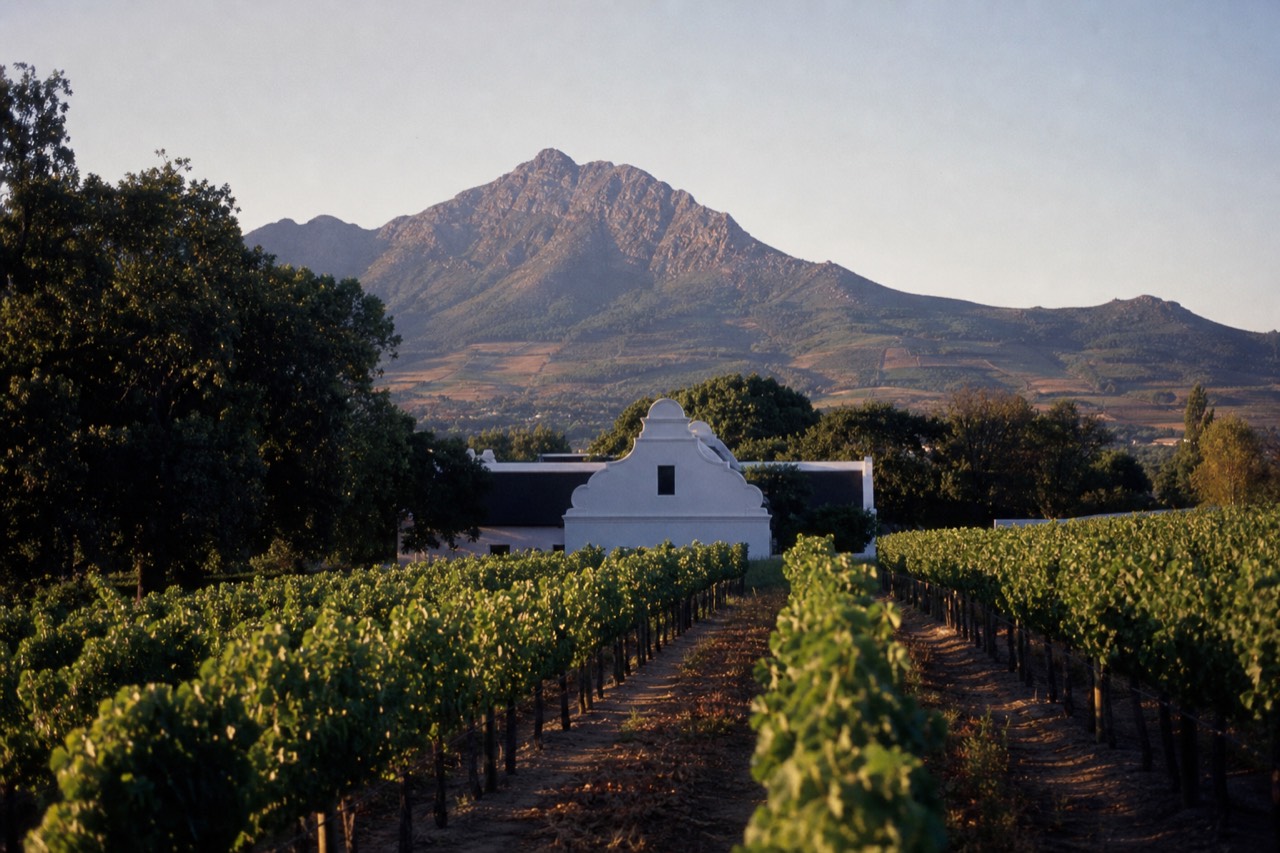
Stellenbosch has more than 150 wine farms and over 100 open cellar doors. The standouts include Kanonkop and Rust en Vrede for reds, Tokara and Delaire Graff for views and food, Jordan and Rustenberg for whites, and Simonsig for Cape sparkling. Most sit minutes apart but are not walkable, so a driver or guided tour makes the day work.
More than 150 wine farms sit inside the Stellenbosch Wine of Origin area, and over a hundred of them open their cellar doors to the public. Nobody drinks their way through all of them. A realistic day fits four or five, so the useful question is which estates earn a place on that short list. The farms below keep winning the Cape's top awards, pour the grapes Stellenbosch built its name on, and welcome visitors rather than selling only to the trade.
Which Stellenbosch wine farms are worth building a day around?
For a first visit, the strongest all-round Stellenbosch wine farms are Kanonkop and Rust en Vrede for reds, Tokara and Delaire Graff for mountain views and food, Jordan and Rustenberg for white wine, Simonsig for Cape sparkling, and Spier or Muratie for history. Most open daily, and most sit within a short drive of the town centre.
There is no single "best" estate, because the right pick depends on what you drink and how you want to spend the day. What the list below has in common is a real reputation, a public tasting room, and a location that fits a normal touring route. A few names, Kanonkop and Rust en Vrede among them, turn up on almost every serious red-wine shortlist. Others earn their place on food, history or the view from the terrace. Spier, Muratie and Delheim also turn up on the short list of the estates that are dog-friendly, worth knowing if a dog is coming along for the day. Start with this table, then read on for what each one actually does well.
| Estate | Ward or cluster | Best known for | Visitor experience |
|---|---|---|---|
| Kanonkop | Simonsberg-Stellenbosch | Pinotage and the Paul Sauer red blend | Tasting room and cellar shop, book ahead |
| Delaire Graff | Top of Helshoogte Pass | Bordeaux-style reds, art and fine dining | Tasting lounge, two restaurants, gardens |
| Tokara | Helshoogte Pass | Chardonnay, Pinotage, olive oil, valley views | Tastings, a glass-walled restaurant and deli |
| Spier | Vlottenburg and Polkadraai | Frans K. Smit reds, a family estate since 1692 | Tastings, restaurants, gardens and picnics |
| Jordan | Stellenbosch Kloof | Chardonnay and Cabernet | Seated tastings and a hilltop restaurant |
| Rust en Vrede | Helderberg, Annandale Road | Red wine only, Cabernet and Syrah | Tasting room and a well-known restaurant |
| Waterford | Blaauwklippen Valley | The Jem blend and a wine-and-chocolate pairing | Tastings, pairings and estate drives |
| Simonsig | Simonsberg, Kromme Rhee | Kaapse Vonkel, the Cape's first bottle-fermented sparkling | Tastings and a cellar tour |
| Warwick | Simonsberg-Stellenbosch | Trilogy and Three Cape Ladies blends | Tastings, lawns and family picnics |
| Thelema | Top of Helshoogte | High-altitude Cabernet | Tasting room with mountain views |
| Rustenberg | Ida's Valley | Peter Barlow Cabernet, Five Soldiers Chardonnay | Tastings and historic gardens |
| Muratie | Simonsberg, Knorhoek | Port-style wines and a cellar from the 1680s | Candlelit, character-heavy tastings |
| Delheim | Simonsberg, Knorhoek | Shiraz and easy-drinking whites | Tastings and a garden restaurant |
| Hartenberg | Bottelary Hills | A Shiraz specialist, a Cape First Growth | Tastings, lunch and cellar visits |
How do the wine farms cluster across the valley?
Stellenbosch estates fall into a handful of clusters: the Simonsberg farms north of town, the Helshoogte Pass estates on the Franschhoek road, the Helderberg farms toward Somerset West, the Bottelary Hills to the northwest, and the Stellenbosch Kloof and Polkadraai farms to the southwest. Each cluster is a short hop, but they are not walkable.
This is the single most useful thing to understand before you plan a visit. The farms are spread over valleys and hills linked by winding country roads, so a sensible day pairs two or three estates in one cluster rather than criss-crossing the region. Pick a direction and stay with it. The map of how the farms cluster on the ground makes the logic obvious once you see it laid out.
| Cluster | Estates | Character | Drive from town |
|---|---|---|---|
| Simonsberg, north | Kanonkop, Muratie, Delheim, Warwick, Rustenberg | Classic reds, history, mountain foothills | About 10-20 min |
| Helshoogte Pass, east | Tokara, Delaire Graff, Thelema | Views, food, art, cooler high sites | About 10-15 min |
| Helderberg, south | Rust en Vrede, Waterford | Big reds and valley drives | About 15-20 min |
| Bottelary Hills, northwest | Hartenberg, Simonsig nearby | Shiraz and quieter roads | About 15-25 min |
| Stellenbosch Kloof and Polkadraai, southwest | Jordan, Spier | Chardonnay and family estates | About 15-20 min |
Because the estates sit apart and the roads twist, someone has to drive, and that person cannot taste. That single fact shapes how most people end up doing the region, which is why the guided day exists in the first place.
What is Kanonkop known for, and can you visit?
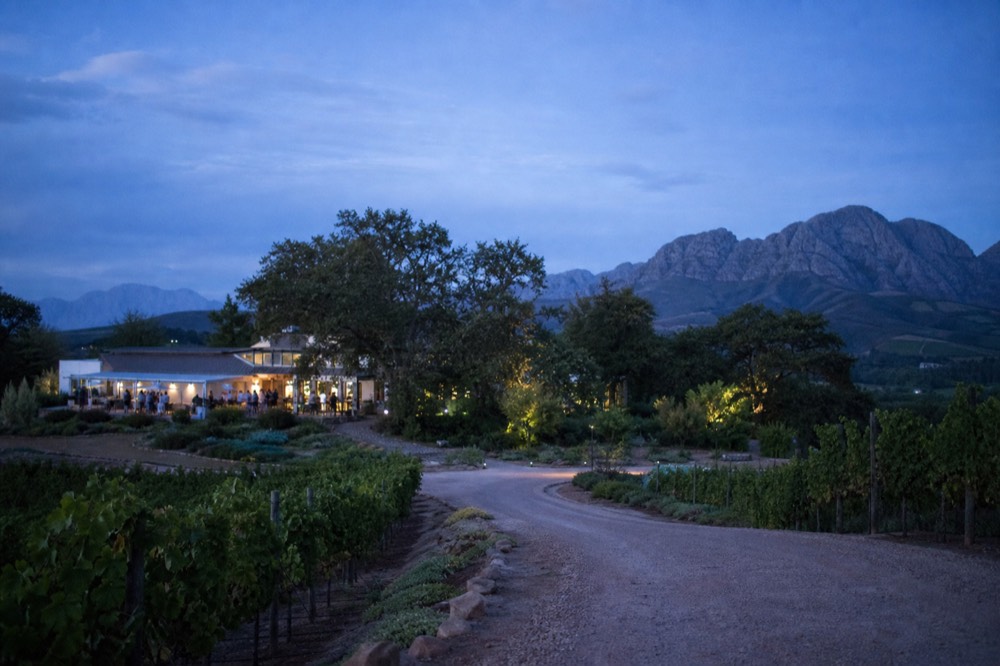
Kanonkop, on the Simonsberg foothills north of Stellenbosch, is the region's most decorated red-wine estate. It built its name on Pinotage, South Africa's own grape, and on the Paul Sauer Bordeaux-style blend. In 2026 it was voted the 17th most admired wine brand in the world, the highest-ranked name from Africa or the Middle East. The tasting room is open to the public, usually by booking.
Pinotage is the Cape's signature red, a cross of Pinot Noir and Cinsaut bred in South Africa in 1925, and few farms handle it better than Kanonkop's estate, which has treated it as a serious wine rather than a curiosity for decades. The background on the grape itself explains why Stellenbosch and Pinotage are so closely tied. A standard tasting at Kanonkop sits near R100 a person, with a Black Label Pinotage add-on around R180 and private portfolio flights running R400 or more. It is one of several farms that shape which wines the region does best.
What makes Delaire Graff and Tokara the estates people photograph?
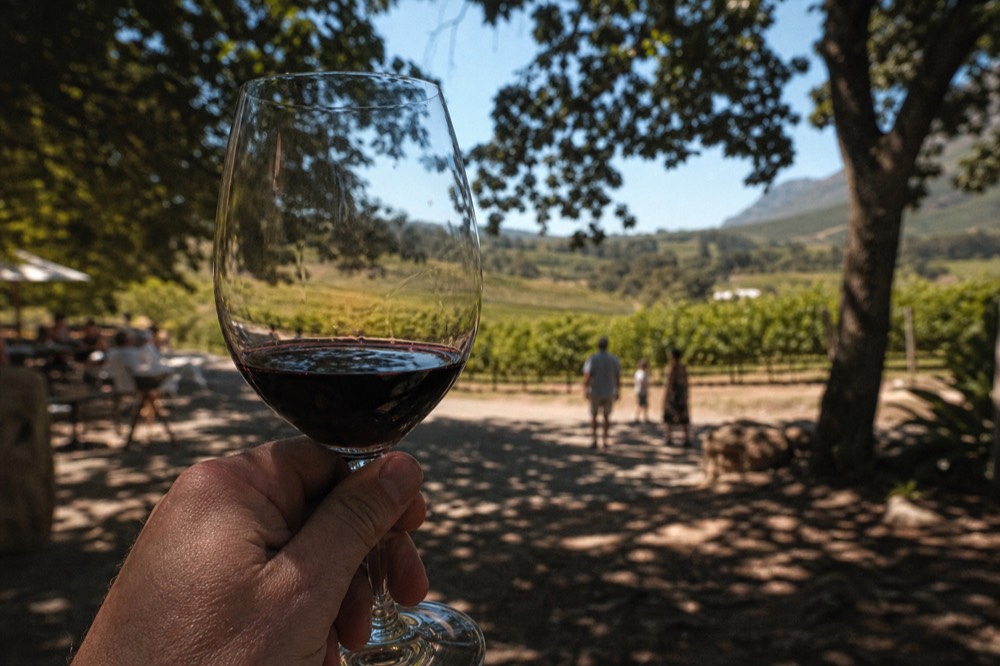
Both sit at the top of the Helshoogte Pass on the road toward Franschhoek, where the altitude opens long views over two valleys. Delaire Graff pairs Bordeaux-style reds with a jewellery designer's art collection and two restaurants. Tokara, across the road, is known for Chardonnay, a Pinotage that took a national title in 2026, an olive mill and a glass-walled restaurant.
Delaire Graff plays the luxury card openly: sculpture on the lawns, a spa and lodge, and a tasting lounge where flights run from about R155 to R500. Its Laurence Graff Reserve 2021 scored 96 points in the 2025 Tim Atkin South Africa report, one of the region's top red results that year. Across the road, Tokara took Pinotage of the Year in the Cape's leading 2026 guide, with tastings from around R120 to R235. Both count among the estates that pair their wines with a proper meal, and both feature in the story of the region's named estates such as Warwick, Thelema and Tokara.
Which farms pour the best reds?
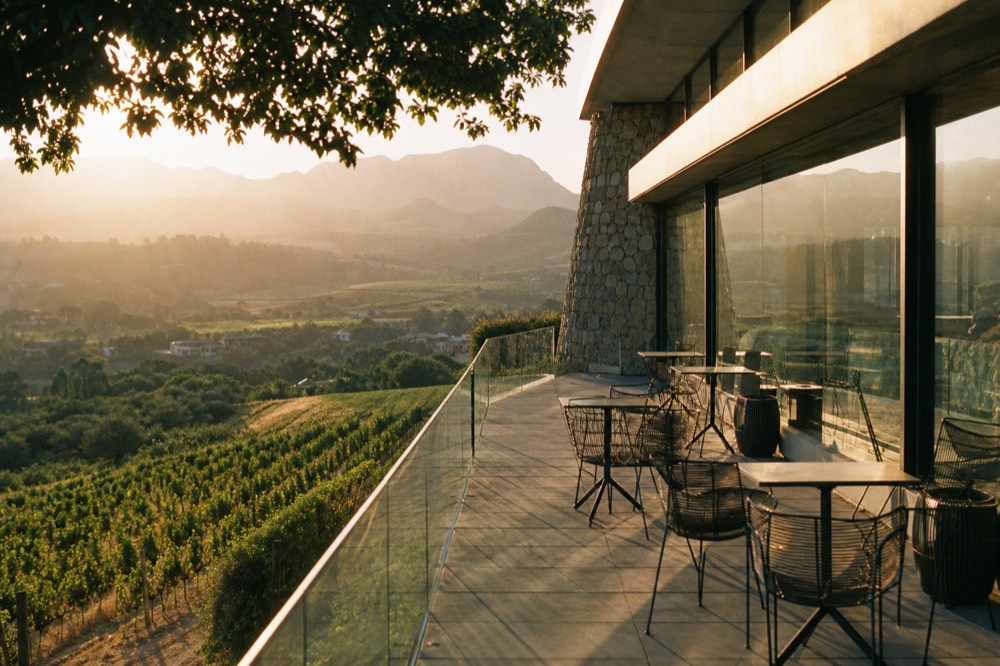
For serious red wine the shortlist is Kanonkop and Rust en Vrede for Cabernet and blends, Waterford for its flagship Jem, Rustenberg for the Peter Barlow Cabernet, Thelema for high-altitude Cabernet, and Hartenberg for Shiraz. Rust en Vrede pours red only. Hartenberg holds a place in the Cape's First Growth classification on the strength of its Syrah.
Stellenbosch is red-wine country first, and the Helderberg farms make the case. Rust en Vrede grows and bottles reds exclusively, and its Estate blend has a long record, once poured at Nelson Mandela's Nobel Prize banquet. A short drive away, Waterford builds its reputation on The Jem, a rich Bordeaux-and-Rhône-style blend, alongside the Kevin Arnold Shiraz. Up on the Simonsberg, Warwick's Trilogy and Rustenberg's single-vineyard Cabernets sit in the same class. If you only have room for one red-focused stop, Kanonkop is the safe answer, but any of these rewards a slow tasting.
Where do the historic estates sit?
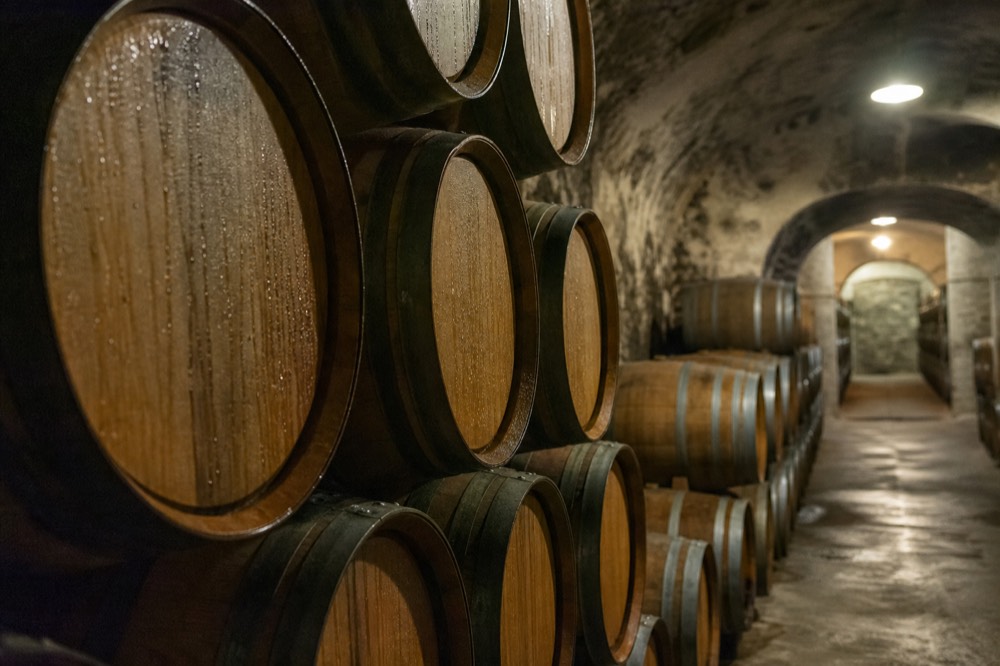
Some of the oldest working farms cluster on the Simonsberg and around the town. Muratie traces its cellar to the 1680s and still pours in candlelight. Simonsig, north of town, made the Cape's first bottle-fermented sparkling wine in 1971. Spier, southwest toward Lynedoch, has farmed since 1692. Just past the district edge, Vergelegen dates to 1700.
History is a real reason to choose a farm here, and it usually comes with atmosphere rather than polish. Muratie's low, rough-walled cellar and Ansela range lean into the estate's age. Simonsig's Kaapse Vonkel started the Cape's sparkling tradition, and the farm picked up three five-star wines in the 2026 guide. Spier, one of the region's oldest, saw its Frans K. Smit Red earn five stars for a fifth time. For the full story of the oldest cellar in the valley, and for a sense of just how many farms there really are, the history stops repay the extra drive.
What does a tasting actually cost at each farm?
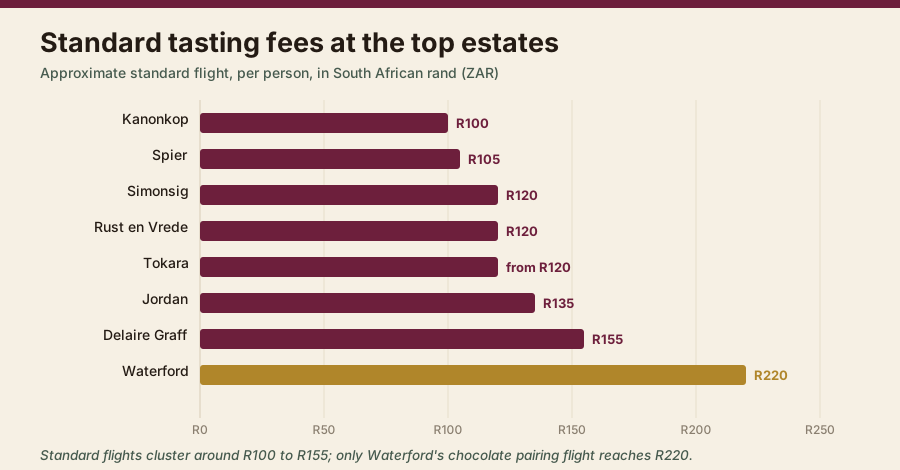
Standard cellar-door tastings in Stellenbosch usually run about R100 to R250 a person for five or six wines, with icon and pairing flights higher. Kanonkop's standard tasting sits near R100, Simonsig and Tokara near R120, Waterford around R220, and Jordan's estate flight around R135. Many farms credit the fee against a bottle you buy.
Individual fees look small until you add four or five of them across a day, then a driver and fuel on top. That arithmetic is where a guided day starts to make sense, and it is set out in full in the breakdown of what a tasting day actually costs. The figures below come from the estates' own current tasting menus, including Waterford's tasting room and Jordan's tasting page.
| Estate | Standard flight (approx, ZAR) | Premium or pairing | Fee credited on purchase? |
|---|---|---|---|
| Kanonkop | R100 | R180 Black Label, R400-450 private portfolio | Yes, on a bottle |
| Waterford | R220 | R200 wine-and-chocolate, up to R435-950 cellar collection | Often |
| Jordan | R135-142 | R460-489 flagship | Often |
| Simonsig | R120 (6 wines) | R365 paint-your-own-bottle experience | Often |
| Spier | R105 | R220 Cellar Collection | Often |
| Tokara | R120-235 | Reserve flights higher | Often |
| Rust en Vrede | About R120 | Estate reserve flights higher | Often |
| Delaire Graff | R155 | Up to R500 icon flights | Often |
For a single price that folds several tastings, cellar tours and lunch into one booking, the three-region full day is the clean comparison against paying cellar door by cellar door, and you can check current dates and prices before you weigh it against a day of separate fees.
Which farms have the best food, and which just pour?
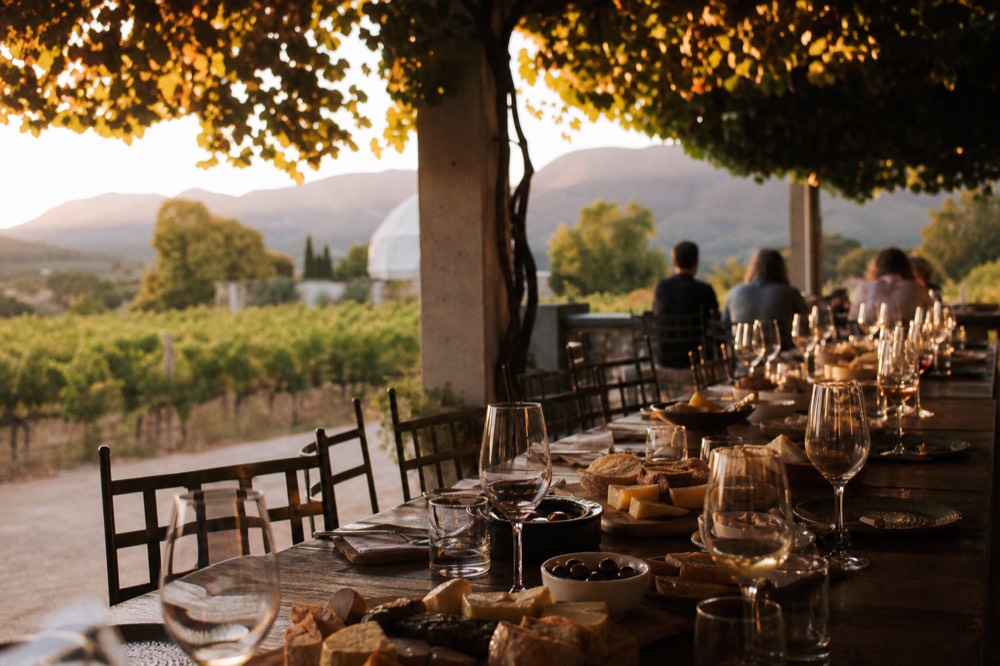
If lunch matters as much as the wine, aim for Delaire Graff, Tokara, Jordan, Rust en Vrede or Spier, all of which run destination restaurants. Waterford is known for a wine-and-chocolate pairing rather than a full menu. On most guided day tours lunch is not automatically included, so check whether a stop is a sit-down meal or a light snack.
This is the detail people most often get wrong. A tour that "visits three estates" may only include tastings and a cheese plate, with lunch left to you at your own cost. If a proper meal on a terrace is the point of your day, choose a route built around the farms that pair their wines with a table, or a chocolate, cheese and wine pairing rather than a straight tasting sprint. The food-and-wine day tours make the meal part of the price instead of an afterthought.
Which estate should you pick for what you like?
Match the farm to the drink. For Pinotage and classic reds, Kanonkop. For a view with the glass, Tokara or Thelema. For Chardonnay, Jordan or Rustenberg. For Cape sparkling, Simonsig. For history and atmosphere, Muratie. For food-led estates, Delaire Graff and Spier. For a red-only cellar, Rust en Vrede.
If you are choosing one or two stops rather than a full circuit, this shortcut saves a lot of second-guessing.
| If you love | Go to | Why |
|---|---|---|
| Pinotage and Cabernet | Kanonkop | The region's most awarded reds, the home of Paul Sauer |
| A view with your wine | Tokara or Thelema | High Helshoogte sites over two valleys |
| Chardonnay | Jordan or Rustenberg | Two of the Cape's benchmark white wines |
| Cape sparkling | Simonsig | Made the country's first bottle-fermented bubbly |
| History and atmosphere | Muratie | A candlelit cellar dating to the 1680s |
| A food-led day | Delaire Graff or Spier | Destination restaurants alongside the tastings |
| Reds only, no compromise | Rust en Vrede | Bottles nothing but red wine |
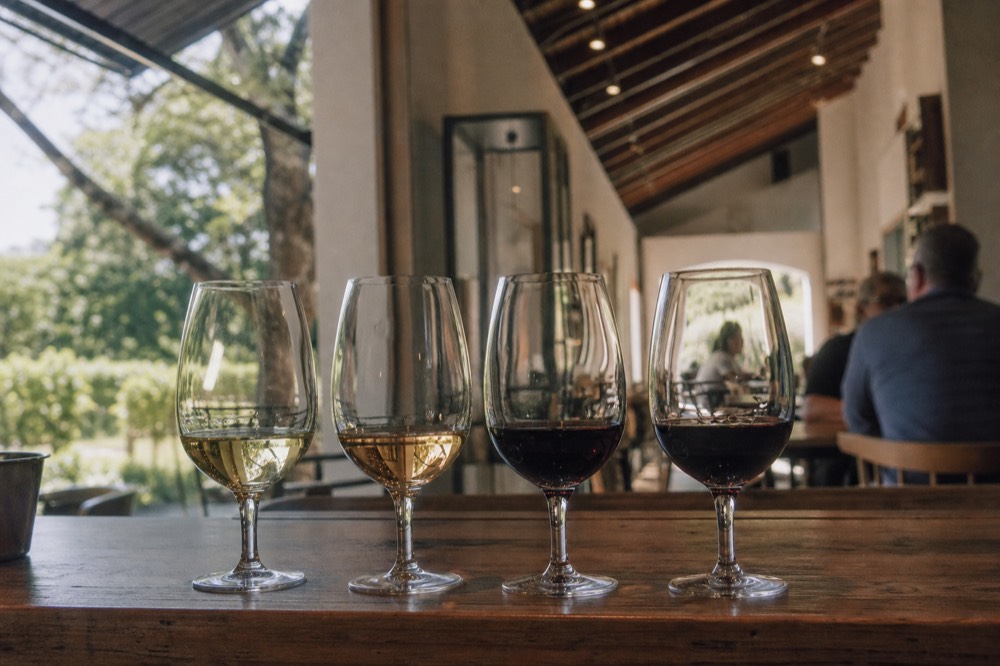
How do guided tours reach these farms?
Most guided days run from Cape Town, about fifty kilometres away, and visit three or four estates chosen by the operator rather than a fixed famous name. A full-day small-group tour costs from around $56 a person and runs about eight and a half hours. A half-day starts near $55 and takes roughly five hours. Private tours build the route around the farms you want.
One honest point: operators rarely publish the exact estates in advance, because the line-up can shift with the season and group size, so treat any named farm as likely rather than promised. What you are buying is the driving, the route and the tastings, not a guaranteed door at Kanonkop. For most first-timers the three-region full-day circuit is the one to book, and you can check current dates and prices for the most-booked full day, or see every option on the homepage, before you commit. If you would rather set your own pace, the hop-on tractor and shuttle passes on the hop-on-hop-off routes cost less up front but leave the tasting fees to you at each farm.
| Tour | Format | Duration | From (USD) | Rating |
|---|---|---|---|---|
| 3 regions, 3 estates, 15 wines | Full day, from Cape Town | About 8.5 h | Around $56 | 4.7 across 2,552 reviews |
| Paarl, Franschhoek & Stellenbosch | Full day, from Cape Town | About 8.5 h | Around $57 | 4.9 across 5,500+ reviews |
| Stellenbosch half-day | Half day, from Cape Town | About 5 h | Around $55 | 4.7 across 827 reviews |
| Wine tractor hop-on-hop-off | Flexible pass | 3 to 10 h | Around $25 | 4.8 across 101 reviews |
| Private full-day | Private, own vehicle | About 8 h | Price on the live listing | 5.0 across 465 reviews |
The most-booked option on this list crosses three towns in a day, with tastings at each and the driving handled the whole way.
If your schedule is tighter, the half-day keeps the format but trims it to a morning or afternoon, with a couple of tastings and a short town walk before the run back. It is the busiest half-day on the list, and a sound first taste of the valley. Compare it against booking a private car over a shared van if you want the route bent around your own picks, and read whether a guided day earns its price before you decide. Either way, a proper Stellenbosch wine tours day handles the one job self-driving cannot.
Many of these tours run starting from Cape Town, which suits visitors basing themselves in the city rather than the winelands.
When is the best time to visit the wine farms?
The farms open year-round. Summer, December to February, brings the best weather and the biggest crowds, so book tastings ahead. Harvest runs February to April, when the cellars are busy and the vineyards smell of fruit. Winter, June to August, is quiet, cooler and cheaper, with easier walk-ins. Spring, September to November, is the calm middle.
Timing changes the character of the day more than most visitors expect. Peak summer weekends fill popular tasting rooms and push you toward reservations; a June weekday can feel like the whole farm is yours.
| Season | Months | Crowds | Why go |
|---|---|---|---|
| Summer | Dec to Feb | Busiest | Warm days, long light, full events calendar |
| Harvest | Feb to Apr | Busy | Cellars working, fruit on the vine |
| Winter | Jun to Aug | Quietest | Cooler, cheaper, easy walk-ins, fireside tastings |
| Spring | Sep to Nov | Moderate | Flowering vines, mild weather, fewer queues |
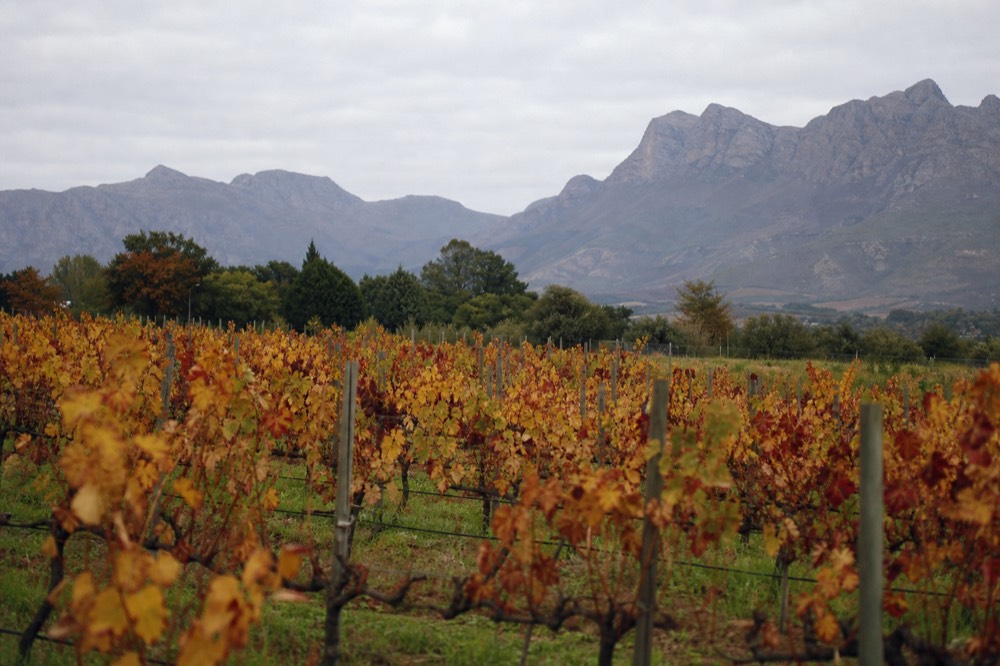
Do you need a driver to visit the wine farms?
Yes, in practice. Stellenbosch's farms are spread across valleys and hills linked by winding roads, not a walkable strip. South Africa's drink-driving limit is 0.05 grams per 100 millilitres, and a tasting flight of small pours adds up fast with no reliable way to judge your own level. A designated driver or a guided tour is the safe way to taste at more than one farm.
A move to a zero-tolerance limit was announced by the transport minister in January 2026, but as of the latest confirmed reporting it has not become law, so 0.05 remains the number that matters. The distances below explain why nobody tastes and drives here: even the short hops between neighbouring farms are real drives on real roads. If you are weighing the region against its neighbour, see how the Franschhoek tram compares and whether to base yourself in Stellenbosch or Franschhoek.
| Route | Distance | Drive time | Note |
|---|---|---|---|
| Cape Town to Stellenbosch | About 50-52 km | 30-45 min | Where most tours start |
| Cape Town airport to Stellenbosch | About 30-35 km | 25-40 min | Common first leg |
| Stellenbosch to Franschhoek | About 30-35 km | 30-40 min | Often combined in one day |
| Stellenbosch to Paarl | About 25-30 km | About 25 min | Often combined in one day |
| Between neighbouring Simonsberg farms | 5-10 km | 10-20 min | Short hops, still a drive |
The town itself is walkable and worth time on its own, with tasting rooms, oak-lined streets and museums; the things to do in Stellenbosch fill the hours around the farms.
Common questions
How many wine farms are there in Stellenbosch?
The official wine route counts more than 150 wine farms in the Stellenbosch Wine of Origin area, with over 100 cellar doors open to visitors and more than 200 registered producers overall. A full breakdown sits in the guide on how many wine farms are in Stellenbosch.
Which is the best wine farm in Stellenbosch?
There is no single winner. Kanonkop is the most awarded for red wine and Pinotage, Tokara and Delaire Graff lead on views and food, Jordan and Rustenberg on Chardonnay, and Simonsig on Cape sparkling. Pick by what you like to drink and how far you want to drive.
Can you visit Stellenbosch wine farms without a car?
Yes. A guided day tour, a hop-on-hop-off tractor or shuttle pass, or a hired driver all work, and none of them ask you to drive after tasting. The farms are not walkable between each other, so some form of transport is needed for more than one stop.
How much is a wine tasting in Stellenbosch?
Standard cellar-door tastings usually run about R100 to R250 a person for five or six wines. Premium, flagship and pairing flights cost more. Many farms credit the fee against a bottle you buy, so a purchase can offset the tasting.
Do you need to book Stellenbosch wine tastings in advance?
In summer and on weekends, yes, especially at popular estates like Kanonkop that ask you to reserve. In winter and midweek, walk-ins are far easier. Guided tours handle the bookings for you as part of the day.
Is Stellenbosch better than Franschhoek for wine?
They are different, not ranked. Stellenbosch has more estates, stronger red wines and a bigger town; Franschhoek leans French, scenic and food-led with its hop-on tram. The comparison of Stellenbosch or Franschhoek weighs both for a first trip.