Wine Farms Near Stellenbosch: A Map of the Clusters and Distances
The farms look scattered on a map, but they fall into a handful of tight clusters. Learn where those clusters sit and how far apart they are, and a tasting day plans itself.
Short answer
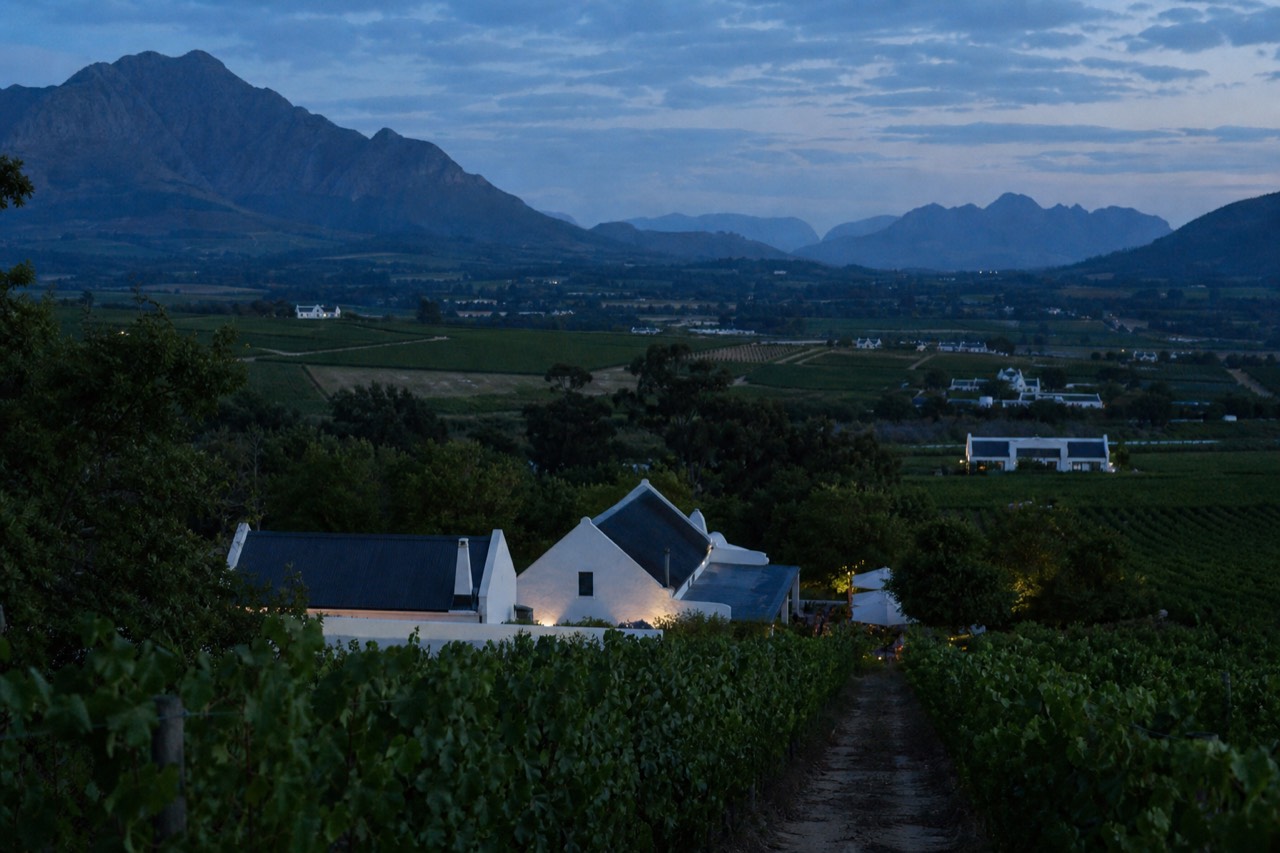
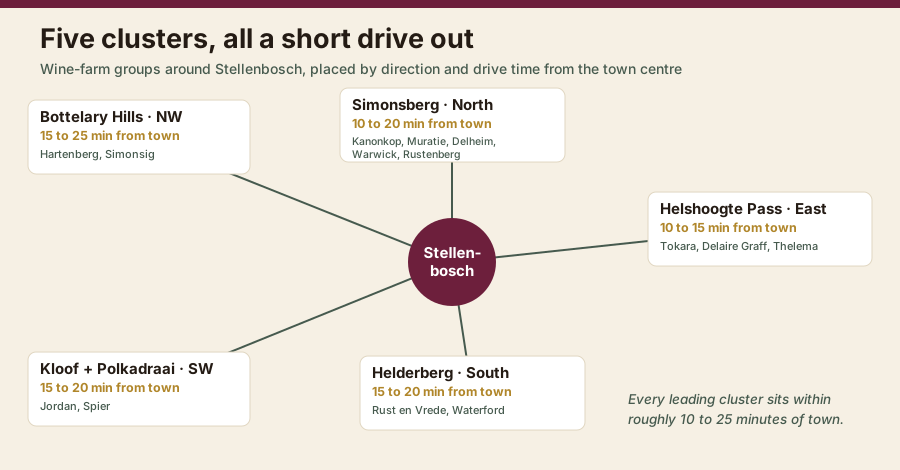
The wine farms near Stellenbosch sit in five main clusters: the Simonsberg farms north of town, the Helshoogte Pass estates on the Franschhoek road, the Helderberg farms toward the south, the Bottelary Hills to the northwest, and the Kloof and Polkadraai farms to the southwest. Each is a 10 to 20 minute drive from the centre, but they are not walkable, so pick one cluster per outing.
Look at a map of the farms around Stellenbosch and they seem scattered, dozens of names dotted across a valley with no obvious order. Stand on one of the estates instead, and the logic snaps into place. The farms group into a handful of clusters, each on its own hill or in its own side-valley, and the smart way to plan a day is to pick one cluster and work it rather than criss-crossing the region. This guide lays out where those clusters sit, how far apart they are, and which farms belong to each.
Where are the wine farms near Stellenbosch, and how are they grouped?
The farms fall into five main clusters: the Simonsberg estates north of town, the Helshoogte Pass estates on the road east toward Franschhoek, the Helderberg farms to the south, the Bottelary Hills to the northwest, and the Kloof and Polkadraai farms to the southwest. Each cluster is a 10 to 25 minute drive from the town centre, and each has its own character.
Understanding the clusters is the single most useful thing before you plan a visit, because it turns a confusing map into three or four easy decisions. The estates spread across valleys and hills linked by winding country roads, so a sensible outing pairs two or three farms in one cluster rather than doubling back across the region. The official Stellenbosch Wine Routes splits the area into sub-routes for exactly this reason. Start with the overview below, then read on for what is in each cluster.
| Cluster | Direction from town | Drive from centre | Character |
|---|---|---|---|
| Simonsberg | North | About 10-20 min | Classic reds, history, mountain foothills |
| Helshoogte Pass | East, toward Franschhoek | About 10-15 min | Views, food, art, cooler high sites |
| Helderberg | South, toward Somerset West | About 15-20 min | Big reds and long valley drives |
| Bottelary Hills | Northwest | About 15-25 min | Shiraz and quieter back roads |
| Kloof and Polkadraai | Southwest | About 15-20 min | Chardonnay and family estates |
The town sits in the middle of all of it, which is why Stellenbosch, rather than any single farm, is the natural base for reaching the most cellar doors. The ranked guide to the best wine farms in Stellenbosch covers what each estate pours; this one is about where they are.
How far apart are the wine farms around Stellenbosch?
Not far in kilometres, but far enough that you drive between them. Neighbouring farms in the same cluster sit 5 to 10 kilometres apart, a 10 to 20 minute hop on country roads. The clusters themselves are 15 to 25 minutes from the town centre. Cape Town is about 50 kilometres away, and Franschhoek and Paarl are each 25 to 40 minutes on from Stellenbosch.
The distances sound trivial until you remember that every one of them is a real drive on a real road, taken by someone who cannot taste. That is the fact that shapes the whole region. Two farms ten minutes apart are still ten minutes of winding tar between tasting rooms, and after a couple of flights the person at the wheel is done drinking for the day. Franschhoek and Paarl sit close enough to fold into the same trip, which is why the comparison of Stellenbosch and Franschhoek matters when you plan a base. The grid below covers the routes you actually use when planning.
| Route | Distance | Drive time |
|---|---|---|
| Cape Town to Stellenbosch | About 50-52 km | 30-45 min |
| Town centre to the Simonsberg farms | 8-15 km | 10-20 min |
| Town centre to the Helshoogte estates | 6-12 km | 10-15 min |
| Town centre to the Helderberg farms | 10-18 km | 15-20 min |
| Between neighbouring farms in a cluster | 5-10 km | 10-20 min |
| Stellenbosch to Franschhoek | About 30-35 km | 30-40 min |
| Stellenbosch to Paarl | About 25-30 km | About 25 min |
What is in the Simonsberg cluster north of town?
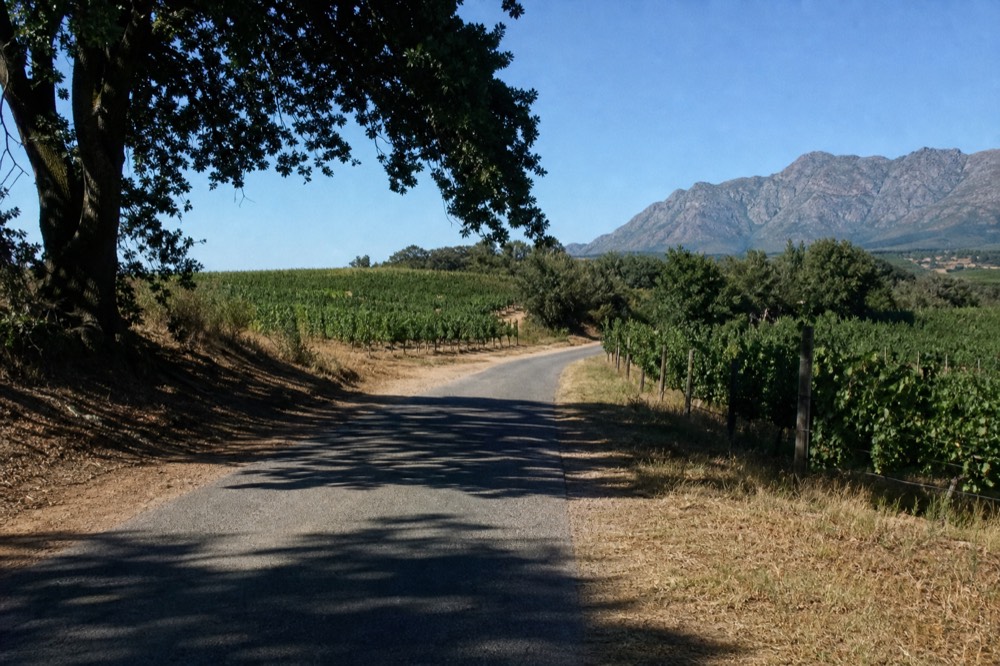
The Simonsberg farms sit on the foothills of the Simonsberg mountain a short drive north of Stellenbosch, and they hold much of the region's red-wine reputation. Kanonkop, Muratie, Delheim, Warwick and Rustenberg cluster here, with Simonsig on the nearby Kromme Rhee road. It is the classic first outing: history, big reds and mountain scenery close together.
If you have one afternoon and want the heart of Stellenbosch red wine, this is the cluster. Kanonkop, the region's most decorated red-wine name, was voted the 17th most admired wine brand in the world for 2026, the highest-ranked from Africa or the Middle East. A few minutes away, Muratie pours in a candlelit cellar that traces its roots to the 1680s, while Warwick and Rustenberg add Bordeaux-style blends and benchmark Cabernet. The farms sit close enough that three in an afternoon is realistic, and the drive between them is part of the pleasure.
What is along the Helshoogte Pass toward Franschhoek?
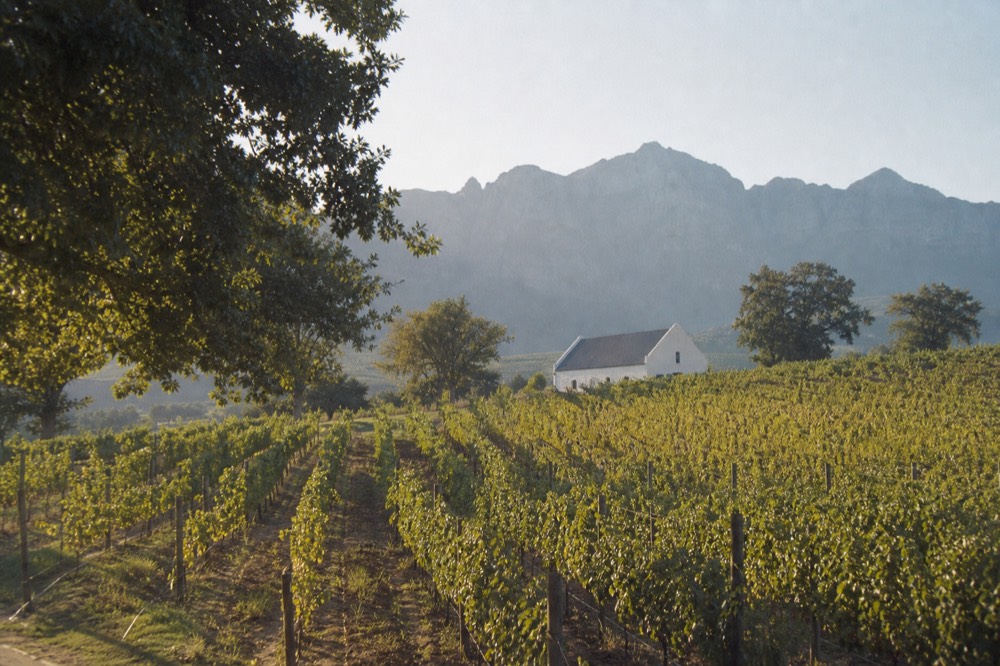
The Helshoogte Pass climbs east out of Stellenbosch on the road to Franschhoek, and the estates at the top trade on altitude and views. Tokara and Delaire Graff face each other near the summit, both known for food as much as wine, with Thelema close by for high-site Cabernet. It is the cluster people photograph, a 10 to 15 minute drive from town.
This is the scenic cluster, where the height opens long views over two valleys and the estates lean into food and design. Delaire Graff plays the luxury card with an art collection and two restaurants, and its Laurence Graff Reserve 2021 scored 96 points in the Tim Atkin South Africa report. Across the road, Tokara took Pinotage of the Year in the Cape's leading 2026 guide alongside a glass-walled restaurant and an olive mill. Because the three sit within a couple of minutes of each other at the top of the pass, this is one of the easiest clusters to combine. Several count among the estates that pair their wines with a proper meal.
If mapping this yourself feels like work, a set route removes the guesswork. The three-region full-day circuit plans the driving and the stops for you, and you can check current dates and prices before deciding whether to hand over the logistics or build your own loop.
Where are the Helderberg and southern farms?
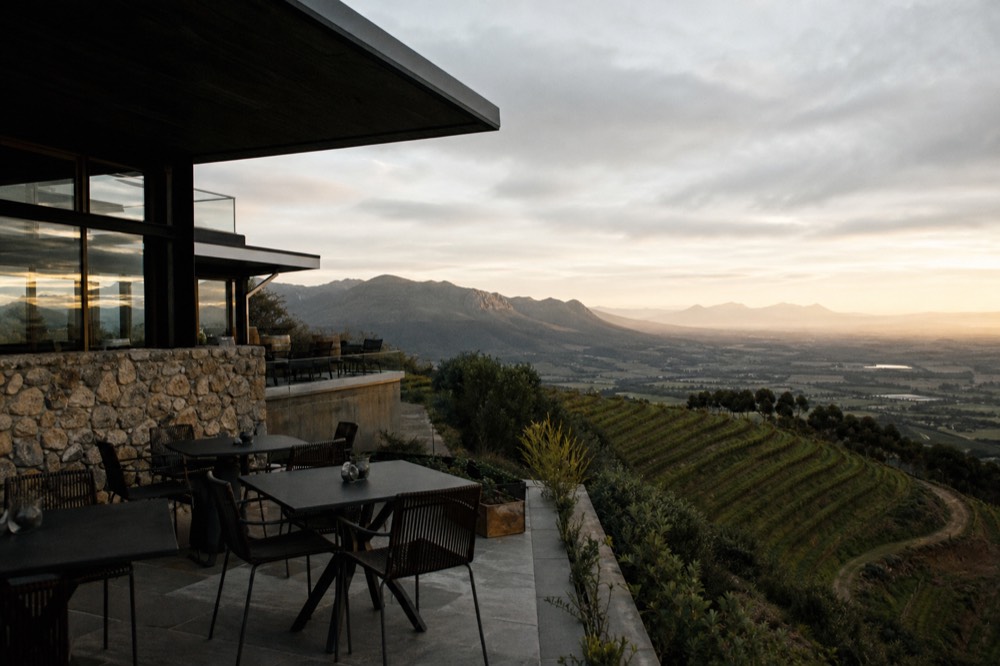
The Helderberg farms lie south of town toward Somerset West, in warmer, lower country built for big reds. Rust en Vrede and Waterford anchor this side, in the Annandale and Blaauwklippen valleys. To the southwest, the Kloof and Polkadraai cluster holds Jordan and Spier, known for Chardonnay and for family-estate scale. Both clusters run 15 to 20 minutes from the centre.
The south of the region divides into two moods. The Helderberg is red-wine country: Rust en Vrede bottles nothing but red, and its estate blend was once poured at a Nobel Prize banquet, while Waterford builds its name on The Jem, a rich Bordeaux-and-Rhone-style blend, and a wine-and-chocolate pairing. Swing southwest instead and the Kloof and Polkadraai farms feel broader and greener, with Jordan's hilltop Chardonnay and Spier's family estate, farmed since 1692, running gardens, restaurants and picnics on a scale that puts it among South Africa's largest wine estates. If white wine or a long lunch is the point of your day, aim here rather than north.
What are the Bottelary Hills and Devon Valley?
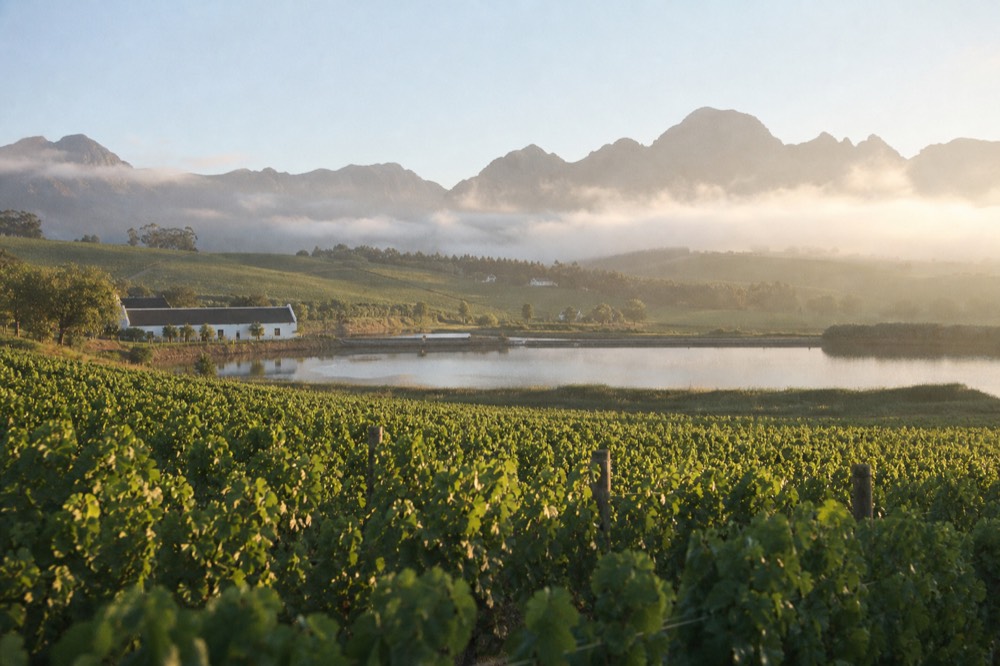
The Bottelary Hills roll northwest of Stellenbosch, quieter country known for Shiraz, with Hartenberg its best-known name and Simonsig on the nearby ridges. Devon Valley is a small, close-in ward just west of the centre, a compact pocket of mostly family-run farms only a few minutes from town. Both reward visitors who want fewer crowds than the headline clusters.
These are the clusters for a second or third visit, when you already know the famous names and want somewhere calmer. Hartenberg, in the Bottelary Hills, holds a place in the Cape's First Growth classification on the strength of its Shiraz, and the back roads out here carry far less traffic than the Helshoogte. Devon Valley, tucked just west of the town, is one of the eight official wards and sits so close to the centre that it barely counts as a drive, which makes it an easy add-on to a town morning. Neither cluster shouts, and that is exactly their appeal.
Here is how the estates fall across the clusters, so you can plan a route around one hill rather than the whole valley.
| Cluster | Estates | Best known for |
|---|---|---|
| Simonsberg, north | Kanonkop, Muratie, Delheim, Warwick, Rustenberg | Classic reds, Pinotage, history |
| Helshoogte Pass, east | Tokara, Delaire Graff, Thelema | Views, food, high-site Cabernet |
| Helderberg, south | Rust en Vrede, Waterford | Big reds, red-only cellars |
| Bottelary Hills, northwest | Hartenberg, Simonsig nearby | Shiraz, quieter roads |
| Kloof and Polkadraai, southwest | Jordan, Spier | Chardonnay, family estates |
What are the eight official wine wards of Stellenbosch?
Under South Africa's Wine of Origin scheme, the Stellenbosch district is divided into eight official wards: Simonsberg-Stellenbosch, Jonkershoek Valley, Banghoek, Papegaaiberg, Bottelary, Devon Valley, Polkadraai Hills and Vlottenburg. These are formal appellation boundaries based on soil and site, and they overlap with, but are not identical to, the touring clusters.
The wards are the legal map rather than the tourist one. They tell you where a wine is grown for labelling purposes, and they explain why farms only a ridge apart can taste so different. Jonkershoek and Banghoek are cooler, higher valleys; Bottelary and Devon Valley sit on the hills west and northwest; Polkadraai and Vlottenburg spread across the southwest. You do not need to memorise them to plan a day, but the ward on a label is a real clue to a wine's style, and the official wine route maps them in full. The blog on how many wine farms are in Stellenbosch breaks down how the 150-plus farms divide across these wards.
| Ward | Rough location | Note |
|---|---|---|
| Simonsberg-Stellenbosch | North, on the mountain foothills | Home of many classic red estates |
| Jonkershoek Valley | East, a narrow high valley | Cool, steep, small production |
| Banghoek | East, above the Helshoogte | High, cooler sites |
| Papegaaiberg | Just west of the town | A small hill on the town's edge |
| Bottelary | Northwest hills | Shiraz and old-vine sites |
| Devon Valley | West, close to town | Compact, mostly family farms |
| Polkadraai Hills | Southwest | Cooler ocean-influenced sites |
| Vlottenburg | Southwest, toward the R310 | Broad valley-floor vineyards |
How do you get between the farms if you are not driving?
A guided day tour handles the whole route and the driving. If you want to move at your own pace, a hop-on-hop-off tractor or shuttle pass loops a fixed set of estates so you board and leave as you like, paying tasting fees at each farm. A private driver or transfer covers the rest. The farms are not walkable between each other, so some form of transport is always needed.
The map only matters once you decide who is driving it. Because the estates sit apart on winding roads, and the drink-driving limit is 0.05, almost nobody self-drives a full tasting day. The cheapest way to string several farms together without your own car is a hop-on pass: a tractor-and-trailer or shuttle that runs a fixed loop while you hop on and off, paying at each cellar door. It trades the polish of a guided day for flexibility and a low seat price. The hop-on tractor and shuttle routes explain how each loop works, and there is a fuller take on whether the tractor is worth it for the DIY-minded.
| Way to move between farms | How it works | Covers | Rough cost |
|---|---|---|---|
| Guided day tour | Set route, driver, tastings | 3-4 estates in one cluster or across regions | From around $56 pp |
| Hop-on tractor loop | Board and leave a fixed trailer route | Estates along one loop | From around $25, fees extra |
| Hop-on shuttle route | Board and leave a fixed van route | Estates on the eastern or northern loop | From around $29, fees extra |
| Private driver or transfer | Door to door, your own picks | Any cluster you choose | Price on the live listing |
The eastern loop is a good example of the hop-on model: a driver and transport carry you between the estates on a flexible day pass, and you pay the tasting fees yourself at each stop. You can check current dates and prices if setting your own rhythm across one of the hop-on loops appeals more than a planned circuit.
For the cheapest way onto the farms at all, the tractor-and-trailer loop lets you taste at your own speed on a fine-weather day, with the seat price kept low because the wine is paid for as you go.
Which cluster should you pick?
Match the cluster to what you want from the day. For classic reds and history, go north to the Simonsberg. For views and food, climb the Helshoogte Pass east. For big reds, head south to the Helderberg. For Chardonnay and family estates, take the Kloof and Polkadraai southwest. For quiet back roads and Shiraz, try the Bottelary Hills.
If you are choosing one cluster rather than a full circuit, this shortcut saves a lot of second-guessing. Pick a direction, commit to it, and you get two or three good farms without spending the day on the road.
| If you want | Head to | Why |
|---|---|---|
| Classic reds and history | Simonsberg, north | Kanonkop, Muratie and the region's oldest red names |
| Views and a long lunch | Helshoogte Pass, east | Tokara and Delaire Graff over two valleys |
| Big reds, red-only cellars | Helderberg, south | Rust en Vrede and Waterford |
| Chardonnay and family estates | Kloof and Polkadraai, southwest | Jordan and Spier |
| Quiet roads and Shiraz | Bottelary Hills, northwest | Hartenberg and calmer back country |
Whichever cluster you choose, the town in the middle is the easy base for all of them, and it is walkable in its own right even though the farms are not. If you are weighing where to start, the Cape Town wine tasting day-trip options cover reaching the valley from the city, and the question of whether you can walk around Stellenbosch sorts out what is on foot and what needs wheels. Between tastings, the things to do in Stellenbosch fill the hours in the town at the centre of the map.
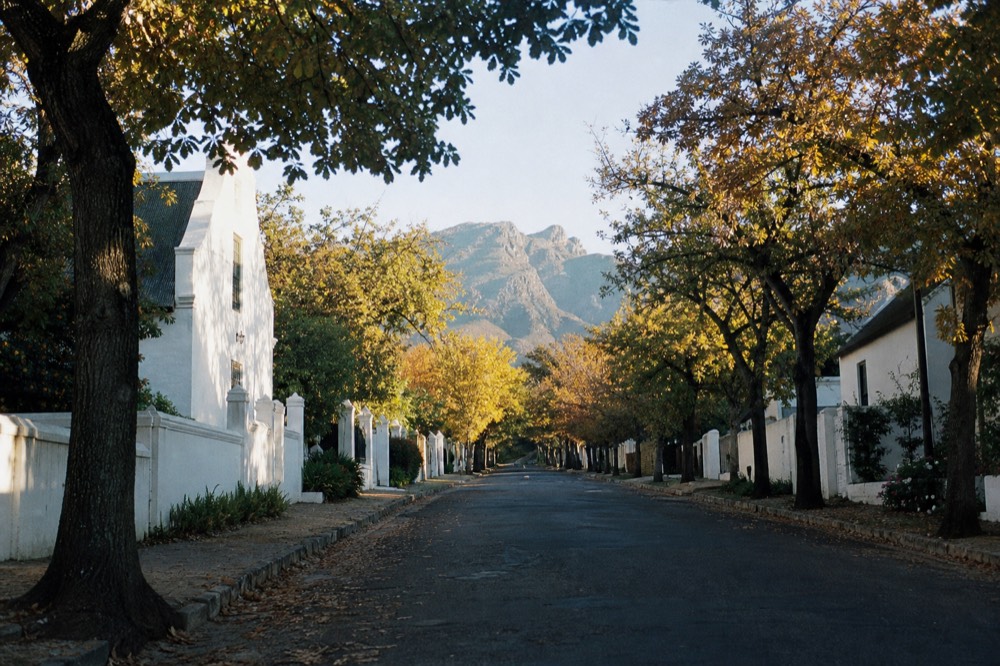
Common questions
How many wine farms are near Stellenbosch?
The official wine route counts more than 150 wine farms in the Stellenbosch Wine of Origin area, with over 100 cellar doors open to visitors and more than 200 registered producers overall. They sit in five main touring clusters spread around the town.
How far apart are the wine farms around Stellenbosch?
Neighbouring farms in the same cluster sit about 5 to 10 kilometres apart, a 10 to 20 minute drive on country roads. The clusters themselves are 10 to 25 minutes from the town centre, and the farms are not walkable between each other.
Which cluster is best for a first visit?
The Simonsberg cluster north of town is the classic first outing, with Kanonkop, Muratie, Delheim, Warwick and Rustenberg close together for reds and history. The Helshoogte Pass east of town is the pick if views and food matter more than reds.
Can you walk between the wine farms in Stellenbosch?
No. The estates are dispersed across valleys and hills linked by winding roads, so touring more than one means a car, a guided tour, or a hop-on-hop-off pass. The town centre itself is walkable, but the farms are not walkable from it or from each other.
What are the eight wards of Stellenbosch?
The Wine of Origin scheme divides the Stellenbosch district into Simonsberg-Stellenbosch, Jonkershoek Valley, Banghoek, Papegaaiberg, Bottelary, Devon Valley, Polkadraai Hills and Vlottenburg. These are formal appellation boundaries based on soil and site, and they overlap with the touring clusters.
Do you need a car to visit the farms near Stellenbosch?
Not your own. A guided day tour, a hop-on tractor or shuttle pass, or a hired driver all reach the farms without asking you to drive after tasting. Because the limit is 0.05 and the estates sit apart, some form of transport is always needed for more than one stop.