Chocolate, Cheese and Wine Pairing in Stellenbosch: What to Expect
Dark chocolate against a Pinotage, a wedge of cheese with a Chardonnay, olives with a crisp white: the pairing tasting turns a flight into a small meal. Here is which Stellenbosch estates do it and what a session really involves.
Short answer
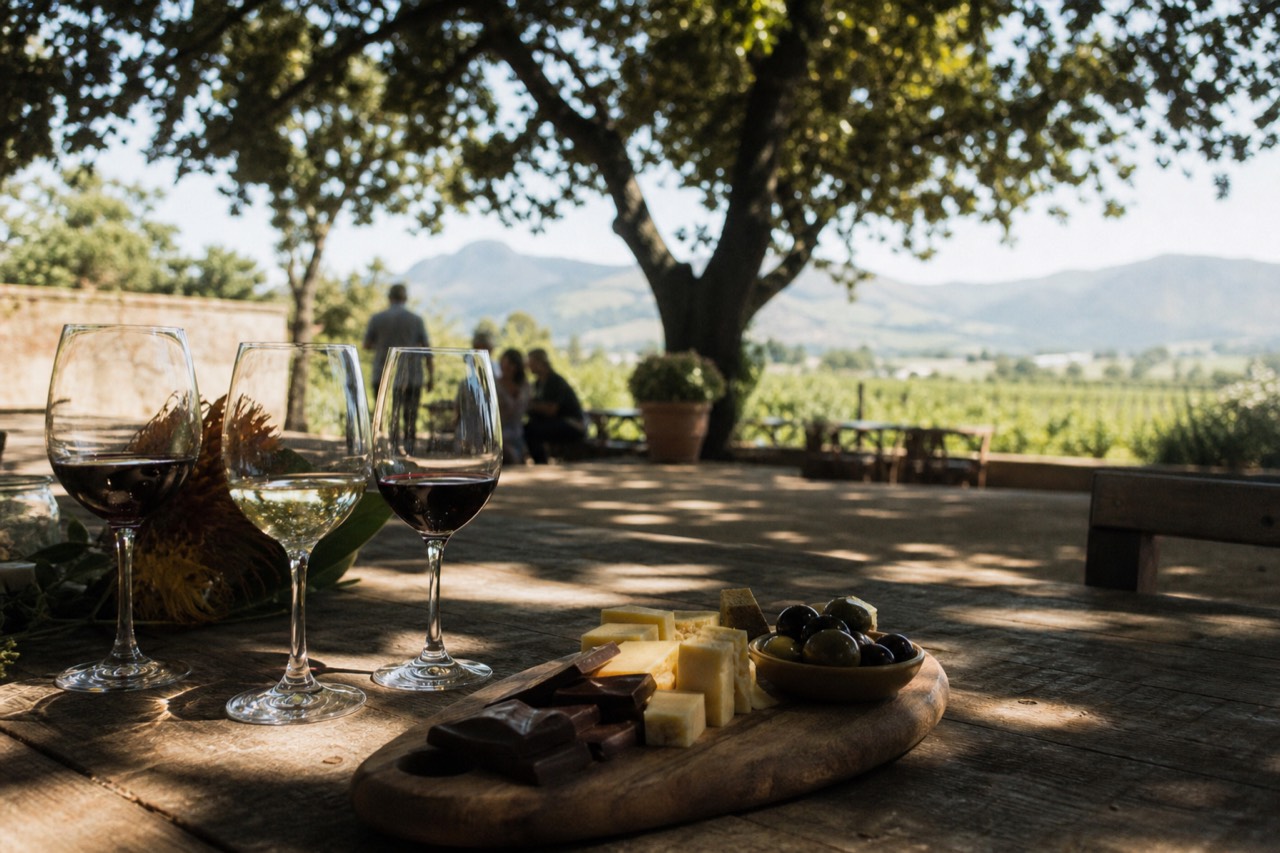
A pairing tasting in Stellenbosch matches small pours with food, most often chocolate, cheese, olives or biltong. Waterford is the region's best-known wine-and-chocolate pairing, and Tokara leans on its own olive oil. Cheese and biltong boards turn up across many tasting rooms and on most day tours. Expect to pay from about R100 to R250 for a standard flight, with pairings often a little more.
Bite a square of dark chocolate, then sip a Pinotage, and the wine changes in your mouth: the tannin softens, the fruit lifts, and two things you thought you knew taste new together. That small trick is the whole point of a pairing tasting, and Stellenbosch does it better than most, because the estates that pour the wine also sit next to some of the Cape's best chocolate, cheese and olive oil. A straight flight shows you the wine. A pairing shows you what the wine is for.
What is a chocolate, cheese and wine pairing in Stellenbosch?
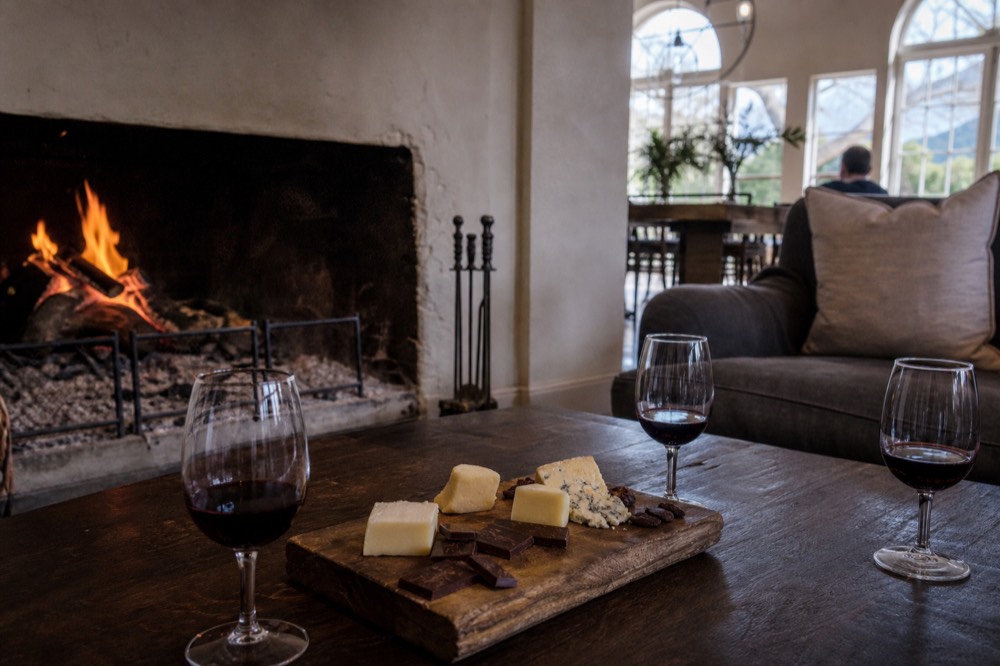
A pairing tasting matches small pours of estate wine with food chosen to flatter each one, usually dark and milk chocolate, local cheeses, olives or biltong. A host walks you through why each match works, often four to six wines with a matching bite. It turns a tasting into a light meal and suits people who find a plain flight too abstract or too much wine on an empty stomach.
The format is more structured than it sounds. Rather than tasting wines back to back, you work through pairs, a wine and the thing meant to sit beside it, and the host explains the logic: sweetness against tannin, salt against acidity, fat against a crisp white. It is a gentler way to taste, because the food slows the pace and gives the alcohol something to work against, which matters across a day of several stops. It is also the most social version of a tasting, better for a group that wants to talk than to study. The elements below are the ones you will meet most often.
| Pairing element | Typical wine match | Why it works |
|---|---|---|
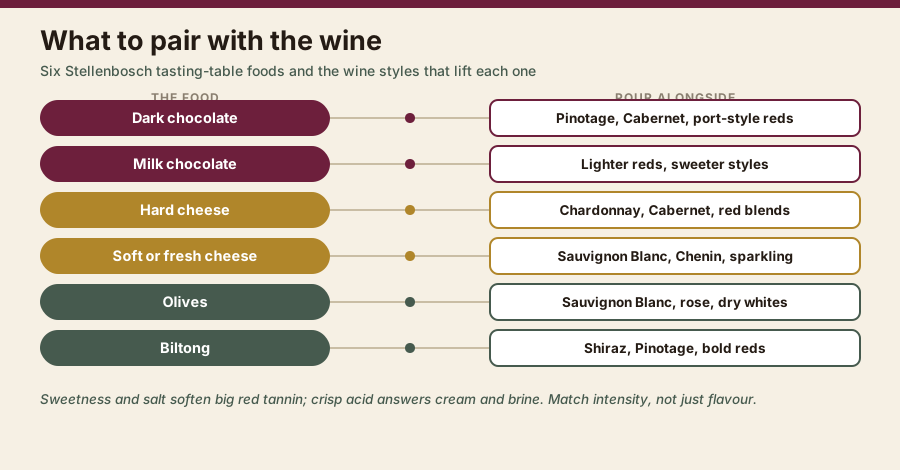
| Dark chocolate | Pinotage, Cabernet, port-style reds | Sweetness and cocoa soften red tannin |
| Milk chocolate | Lighter reds, sweeter styles | Creamy sugar meets soft fruit |
| Hard cheese | Chardonnay, Cabernet, red blends | Fat and salt lift acidity and structure |
| Soft or fresh cheese | Sauvignon Blanc, Chenin, sparkling | Crisp acid cuts through the cream |
| Olives | Sauvignon Blanc, rosé, dry whites | Brine and salt sharpen a crisp white |
| Biltong | Shiraz, Pinotage, bold reds | Cured, savoury meat suits a big red |
These matches are a common starting point rather than a rulebook, and the estates worth building a tasting around appear in the ranked guide to the best wine farms in Stellenbosch.
Which estates do the best wine-and-chocolate pairing?
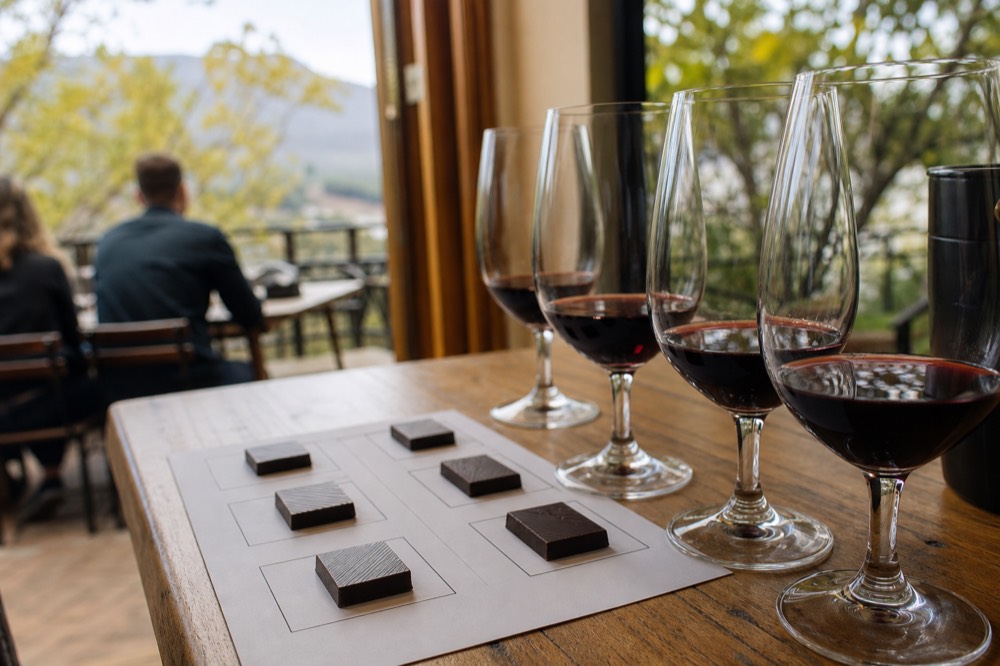
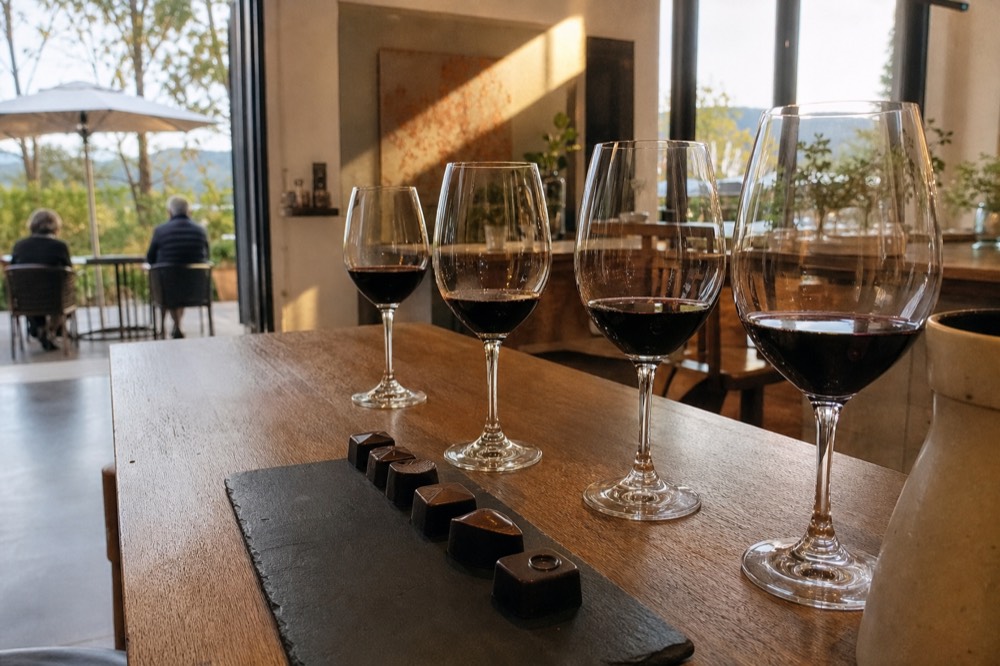
Waterford Estate, in the Blaauwklippen Valley, runs the region's best-known wine-and-chocolate pairing, matching its reds and blends with chocolates made to complement them, usually around R200 to R220. Several other estates offer chocolate on a premium flight, but Waterford is the one people book specifically for the pairing rather than as an add-on to a normal tasting.
Chocolate and wine is the pairing most visitors picture, and Waterford turned it into a signature. The estate matches specific chocolates to specific wines, so the exercise is deliberate rather than a bowl of squares beside the glass, and it sits at the premium end of the tasting menu rather than the standard flight. You can see the current options on Waterford's tasting room page. Chocolate flatters red wine for a real reason: the sweetness and cocoa take the edge off tannin, which is why Pinotage, Cabernet and port-style reds handle it best. If you want to understand which wines the region does best before you pair them, that guide sets out the grapes Stellenbosch built its name on.
What about cheese, olive and biltong pairings?
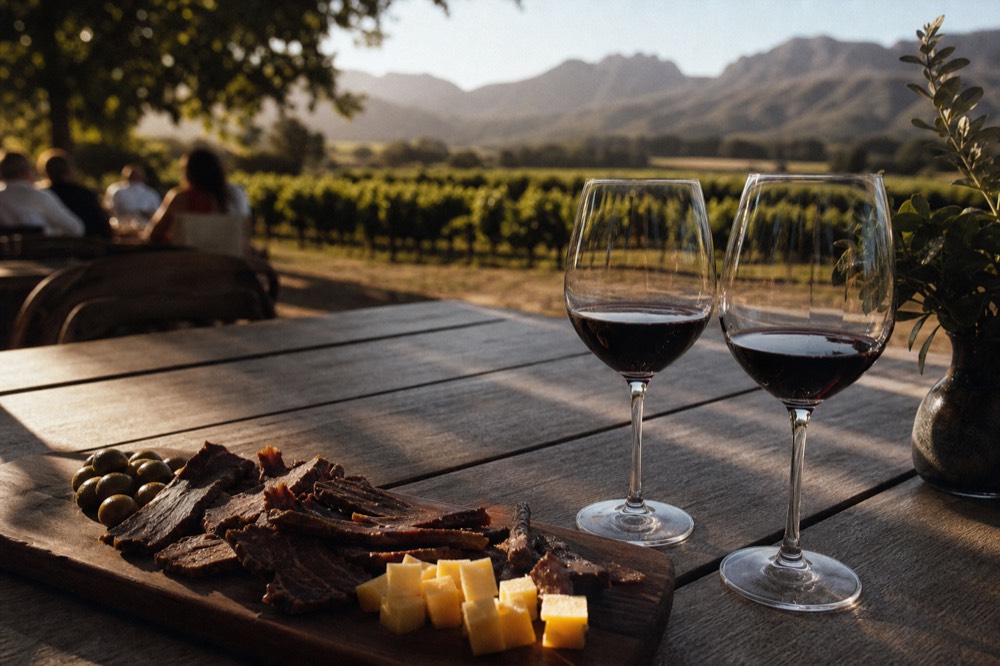
Cheese and biltong boards show up across many tasting rooms and on most day tours, less as a named experience and more as a plate that arrives with the wine. Olive pairings lean on estates with their own oil, Tokara chief among them, thanks to its olive mill on the Helshoogte Pass. Biltong, the local cured meat, pairs with bold reds and appears on several Stellenbosch half-day and full-day tours.
Beyond chocolate, the pairing spreads out. Cheese is the most common companion, a board of hard and soft styles set beside a flight, and it works because fat and salt lift both a crisp white and a structured red. Olives are the quieter partner, at their best with a Sauvignon Blanc or a dry rosé, and the estates that press their own olive oil tend to take them seriously; Tokara is the obvious name, with an olive mill alongside the cellar. Biltong is the South African wildcard, a dried, spiced beef that stands up to a Shiraz or a Pinotage, and it turns up on the pairing plate more often here than anywhere else in the wine world. For the estates that also put a proper kitchen next to the tasting room, the guide to wine farms with restaurants is the companion to this one.
| Pairing | Where it shines | What to look for |
|---|---|---|
| Wine and chocolate | Waterford, premium flights elsewhere | A set pairing, not a bowl of squares |
| Wine and cheese | Most tasting rooms, day tours | A board of hard and soft styles |
| Wine and olives | Estates with their own oil, like Tokara | Olives and oil beside a crisp white |
| Wine and biltong | Half-day and full-day tours | Cured, spiced beef with a bold red |
How does a pairing tasting work, and what does it cost?
A pairing runs like a guided flight with food: the host pours a wine, hands you the bite meant to go with it, and explains the match before you move on. Standard tastings in Stellenbosch cost about R100 to R250 a person; pairings usually sit at the upper end or a little above, with Waterford's chocolate pairing near R200 to R220. Many estates credit the fee against a bottle you buy.
The cost sits in the same band as a normal tasting, nudged up for the food and the guiding. A plain flight might be R100 at Kanonkop or R120 at Tokara; a pairing adds the chocolate, cheese or olives and the host's time, so it lands nearer the top of the range or just past it. As with any tasting, the fee is often waived or credited if you buy a bottle, which softens the price if you plan to take wine home. Where the sums really matter is across a whole day, when several pairings, a driver and fuel stack up, exactly the arithmetic laid out in the breakdown of what a tasting day actually costs.
| Estate | Standard tasting (approx, ZAR) | Pairing or premium option |
|---|---|---|
| Waterford | R220 | Wine-and-chocolate pairing, around R200-220 |
| Tokara | R120-235 | Reserve flights and olive-oil tastings higher |
| Kanonkop | R100 | Black Label add-on around R180 |
| Spier | R105 | Cellar Collection around R220 |
| Simonsig | R120 | Cap Classique and premium flights higher |
| Delaire Graff | R155 | Icon flights up to around R500 |
Is a pairing tour better than doing it estate by estate?
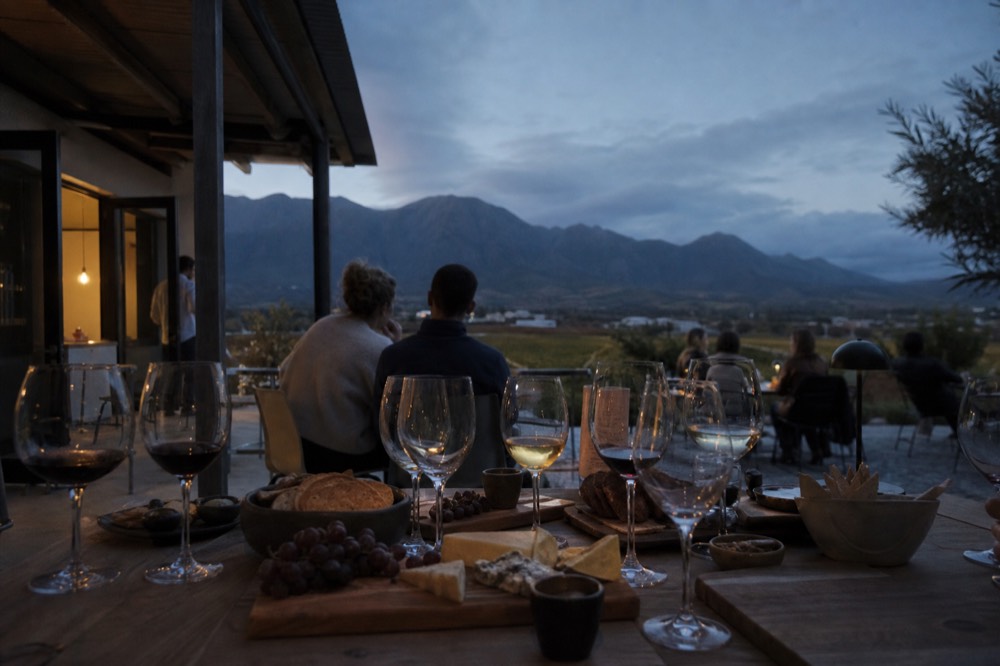
A pairing tour usually wins on cost and hassle. Booking pairings yourself means paying at each cellar door, planning the route, and finding a sober driver between farms that are not walkable. A food-and-wine tour folds several pairings, transport and the driving into one price. Doing it yourself only pays off if you have a designated driver and want just one or two stops near your base.
The honest comparison comes down to the driver and the arithmetic. Arrange pairings independently and you pay fee after fee, map the day, and hand one person the keys and a glass of water, because South Africa's drink-driving limit is 0.05 grams per 100 millilitres and a run of pairings passes it quickly. A move to a zero-tolerance limit was announced by the transport minister in January 2026, but it has not become law, so 0.05 remains the number. A guided food-and-wine day removes both problems, and you can check current dates and prices for the full pairing day before you weigh it against the do-it-yourself route. If comfort and a custom itinerary matter more than price, the look at private versus group wine tours sets out the trade-offs.
| Approach | Cost | Driver | Flexibility |
|---|---|---|---|
| Pairing tour, food-led | One price, pairings and transport in | Handled by the operator | Set route, everyone tastes |
| All-inclusive private day | Higher, fees folded in | Handled, own vehicle | Route built around you |
| Do it yourself, estate by estate | Pay at each cellar door | You need a sober driver | Total freedom, more planning |
The full pairing day is the clearest way to do this without doing the arithmetic on the day, leaning on food as much as wine across several estates.
Which pairing suits which wine you like?
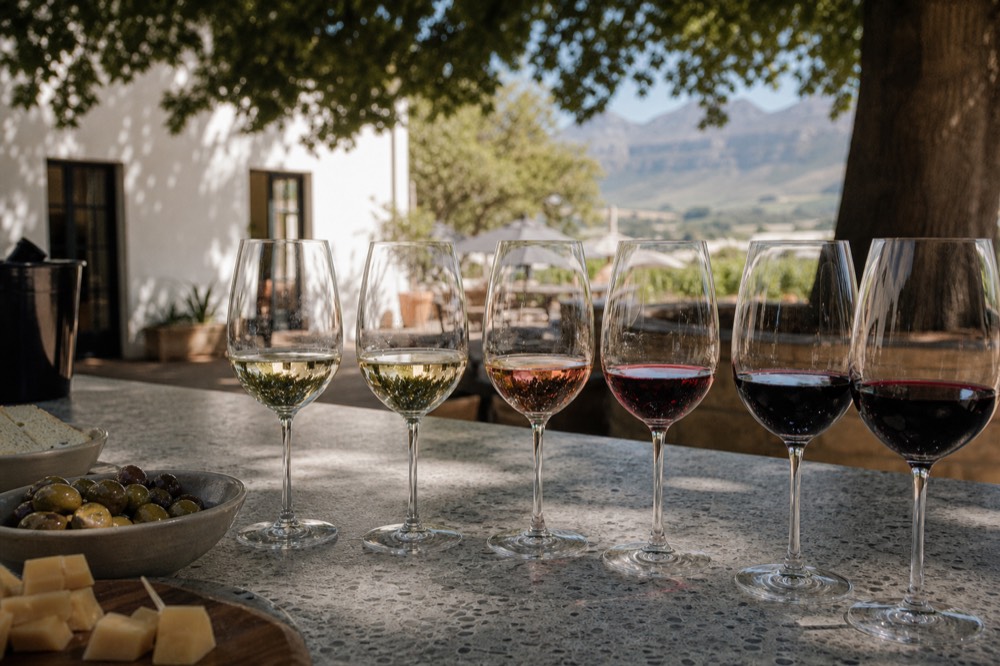
Match the food to your favourite glass. If you love Pinotage or Cabernet, chocolate and biltong bring out the fruit and tame the tannin. For Chardonnay or a red blend, hard cheese is the classic partner. For Sauvignon Blanc, Chenin or Cape sparkling, aim at olives, fresh cheese or something briny. Sweeter and port-style wines take dark chocolate best of all.
If you are choosing a single pairing rather than a full spread, working from the wine you already like saves guesswork. Stellenbosch is red-wine country first, so chocolate and biltong get a lot of use here, sitting naturally beside the region's Pinotage, Cabernet and Shiraz. Whites and sparkling wines want the opposite, something salty or fresh to sharpen them, which is where olives and lighter cheeses come in. None of this is fixed, and half the fun is finding a match the host did not suggest, but the shortcuts below get you started.
| If you love | Try pairing with | The idea |
|---|---|---|
| Pinotage, Cabernet | Dark chocolate, biltong | Sweetness and salt soften big tannin |
| Chardonnay, red blends | Hard, aged cheese | Fat and structure meet in the middle |
| Sauvignon Blanc, Chenin | Olives, fresh cheese | Brine and acid sharpen a crisp white |
| Cape sparkling | Salty snacks, soft cheese | Bubbles cut through richness |
| Port-style, sweet reds | Dark chocolate | Sugar answers sugar, cocoa answers fruit |
Do the shorter tours include pairings too?
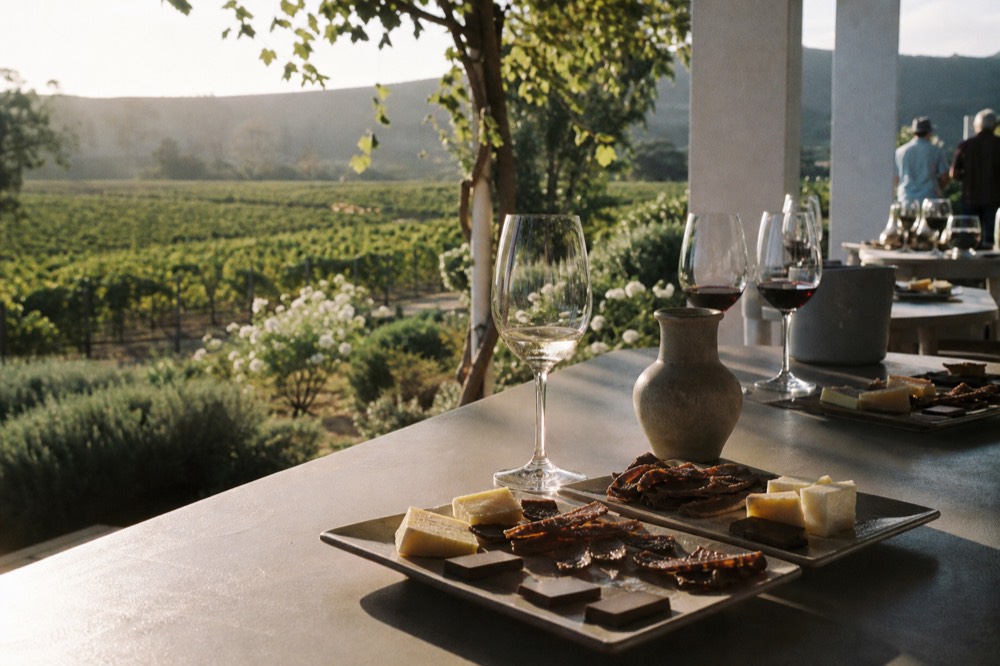
Yes. The Stellenbosch half-day out of Cape Town builds cheese, biltong and chocolate pairings into its two tastings, so you get the pairing idea without a full food-led day. It suits a tight schedule or a first visit, and costs less than the dedicated pairing tour. The all-inclusive private day goes the other way, folding personalised pairings and the fees into one price.
Not everyone wants a whole day at the pairing table, and the shorter formats cover that. The half-day keeps the pairing element, cheese, biltong and chocolate alongside a couple of tastings and a town walk, then has you back by mid-afternoon; it is the most-reviewed half-day on this site's list. You can check current dates and prices for it if a lighter first taste is what you are after. At the other end, a private all-inclusive day makes the pairings personal and removes the fee-by-fee arithmetic, which suits couples and small groups who would rather not think about money at each cellar door.
For the private version, where the pairings and the pace are shaped around your group, the all-inclusive day is the natural pick.
When is the best time to book a pairing experience?
Pairings run year-round, but spring and autumn are the easy shoulders for weather and space, September to November and March to May. Summer, December to February, is warm, busy and needs booking ahead. Winter, June to August, is quiet and cheaper, and a pairing suits the cooler months well, with reds, chocolate and a fire making more sense than a hot-weather flight.
Season shapes the pairing more than you might think. A warm summer afternoon leans toward crisp whites, olives and lighter cheese, while a cold winter day is exactly when chocolate, biltong and a fireside red come into their own. Winter also brings quieter tasting rooms and easier bookings, so a pairing you might struggle to fit in on a summer Saturday is a walk-in on a July weekday. If you are lining up the pairing as part of a broader trip, the round-up of things to do in Stellenbosch and the ideas for more unusual ways to spend a day help fill the hours around the table.
| Season | Months | The pairing scene |
|---|---|---|
| Spring | Sep to Nov | Mild, clear, easy bookings, fresh whites |
| Summer | Dec to Feb | Warm and busy, book ahead, lighter pairings |
| Autumn | Mar to May | Harvest colour, fine weather, reds returning |
| Winter | Jun to Aug | Quiet, cheaper, fireside reds and chocolate |
Common questions
Which Stellenbosch estate does the best chocolate and wine pairing?
Waterford Estate in the Blaauwklippen Valley runs the region's best-known wine-and-chocolate pairing, matching specific chocolates to its reds for around R200 to R220. Several other estates offer chocolate on a premium flight, but Waterford is the one people book for the pairing itself.
What does a wine pairing tasting cost in Stellenbosch?
A standard flight runs about R100 to R250 a person, and pairings usually sit at the upper end or a little above for the added food and guiding. Many estates credit the fee against a bottle you buy, which offsets the cost if you take wine home.
Do stellenbosch wine tours include chocolate and cheese pairings?
Many do. The dedicated food-and-wine day is built around pairings, and the Stellenbosch half-day from Cape Town includes cheese, biltong and chocolate alongside its tastings. Always check the specific listing, since the amount and style of pairing varies by tour.
What wine goes best with dark chocolate?
Bold reds and sweeter styles. Pinotage, Cabernet and port-style wines handle dark chocolate best, because the cocoa and sugar soften the tannin and lift the fruit. Milk chocolate suits lighter, sweeter reds. It is one of the easiest pairings to get right at a Stellenbosch tasting.
Can you pair wine with biltong?
Yes, and Stellenbosch does it more than most. Biltong is a dried, spiced South African cured meat, and its savoury, salty character stands up to a Shiraz or a Pinotage. It appears on many local pairing plates and day-tour tastings as a regional twist on the usual cheese board.
Is a pairing tour worth it over doing it yourself?
Usually, unless you have a sober driver and want only one or two stops. A food-and-wine tour folds several pairings, transport and the driving into one price, while doing it yourself means paying at each cellar door and someone staying sober to drive between farms that are not walkable.