The Stellenbosch Wine Tractor and Hop-On Hop-Off: Is It Worth It?
There is no tram in Stellenbosch. Its version of the hop-on-hop-off day is an open tractor-and-trailer and a set of shuttle loops, and the low seat price is only half the story.
Short answer
Stellenbosch's hop-on-hop-off day runs on an open wine tractor and shuttle loops, not the tram that people picture from Franschhoek. A seat starts around $25, but tasting fees are paid at each farm, so budget R100 to R250 per stop on top. It suits an unhurried, self-paced day rather than a set itinerary.
People search for the Stellenbosch wine tram and find, quietly, that it does not exist. The tram is Franschhoek's, one valley over. Stellenbosch answers the same idea in two different ways: an open tractor-and-trailer that loops a set of estates, and a handful of shuttle routes you hop on and off across the day. Both trade a fixed guided itinerary for freedom and a low seat price. Whether that freedom is worth it depends almost entirely on a cost the headline number hides.
What is the Stellenbosch wine tractor?
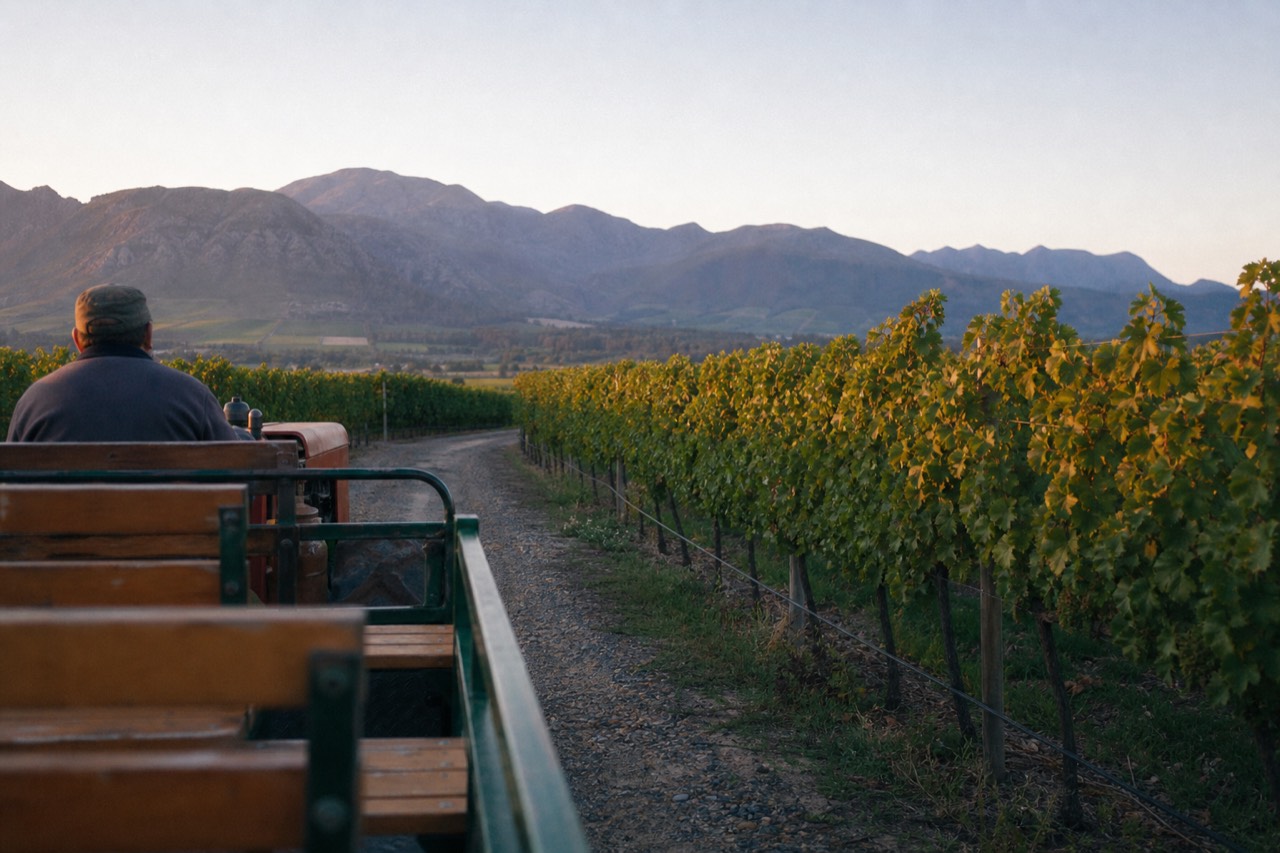
The Stellenbosch wine tractor is an open tractor-and-trailer that runs a fixed loop of estates, letting you hop on and off to taste at your own pace. Stellenbosch has no wine tram, which is Franschhoek's, but it does have this tractor plus several hop-on-hop-off shuttle loops. A seat starts around $25, and the tasting fees at each farm are paid separately as you go.
The confusion is understandable. The Franschhoek Wine Tram is famous, so visitors assume Stellenbosch runs one too. It does not. What Stellenbosch offers instead is arguably more flexible and certainly cheaper to board: an open trailer towed behind a tractor, rolling between cellar doors on a set route, plus shuttle-based loops that cover the northern and eastern clusters of the valley. You choose where to get off, how long to linger, and which wines to pay for. The official wine route maps the sub-regions these loops thread through. If the tram itself is what you are weighing, the tram versus a Stellenbosch tour comparison sets them side by side.
How does the hop-on-hop-off system work?
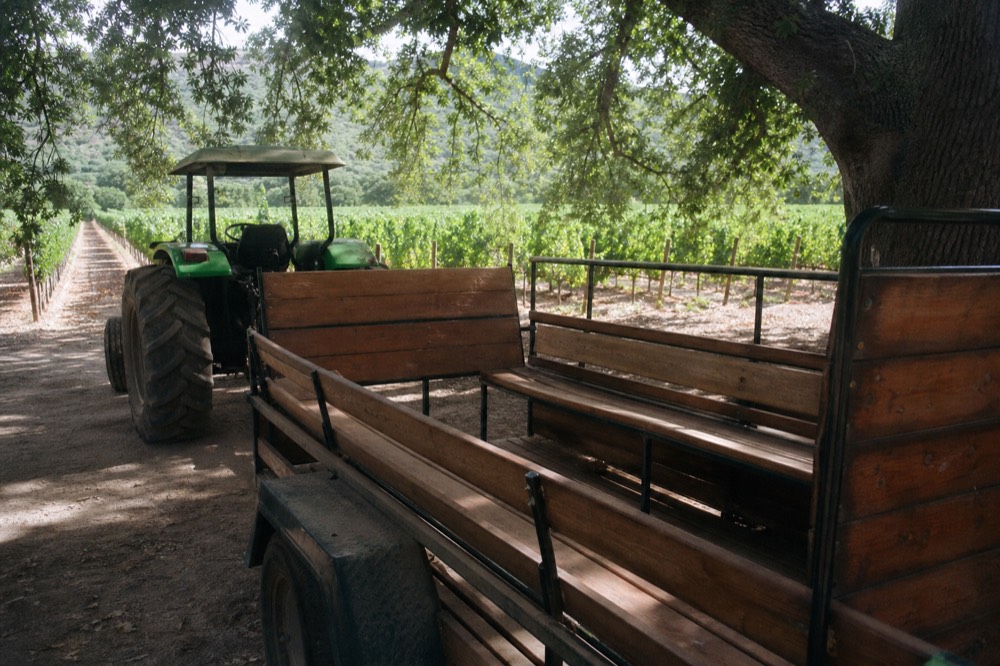
You buy a seat on the tractor or a shuttle pass for the day, then ride a fixed loop of estates, getting off wherever you like and catching the next vehicle when you are ready to move on. Tastings are paid at each cellar door, not bundled into the fare, so the pass covers the transport and you cover the wine. Loops typically run every 30 to 60 minutes across the day.
The rhythm is the whole appeal. Instead of a guide marching a group through three set estates on the clock, you set the pace: a long lunch at one farm, a quick flight at the next, a skipped stop if it looks busy. The trade is that nothing is included beyond the ride. Each estate charges its own tasting fee at the counter, usually R100 to R250 for a standard flight, which the guide to what a tasting day really costs breaks down farm by farm. It also means you carry the planning: which stops, how long, and whether you will make the last loop back.
| Pass | Format | Duration | From (USD) | Tastings |
|---|---|---|---|---|
| Wine tractor hop-on-hop-off | Open tractor and trailer, fixed loop | Flexible, 3 to 10 h | Around $25 | Paid at each farm |
| Eastern Route hop-on | Shuttle, eastern loop day pass | Flexible day | Around $29 | Paid at each farm |
| Vine Hopper, Northern Route | Shuttle, northern loop | About 8 h | Price on the live listing | Paid at each farm |
| Vineyard wine walk, 8 tastings | Guided walk, on foot | 3 to 4 h | Around $79 | 8+ tastings included |
The wine walk is the outlier: it swaps the ride for a guided walk through private vineyards with the tastings built in, which makes it a different product with a very different cost logic. Everything else on the list is a ride you pay to board, then pay again to drink.
What routes are there and where do they go?
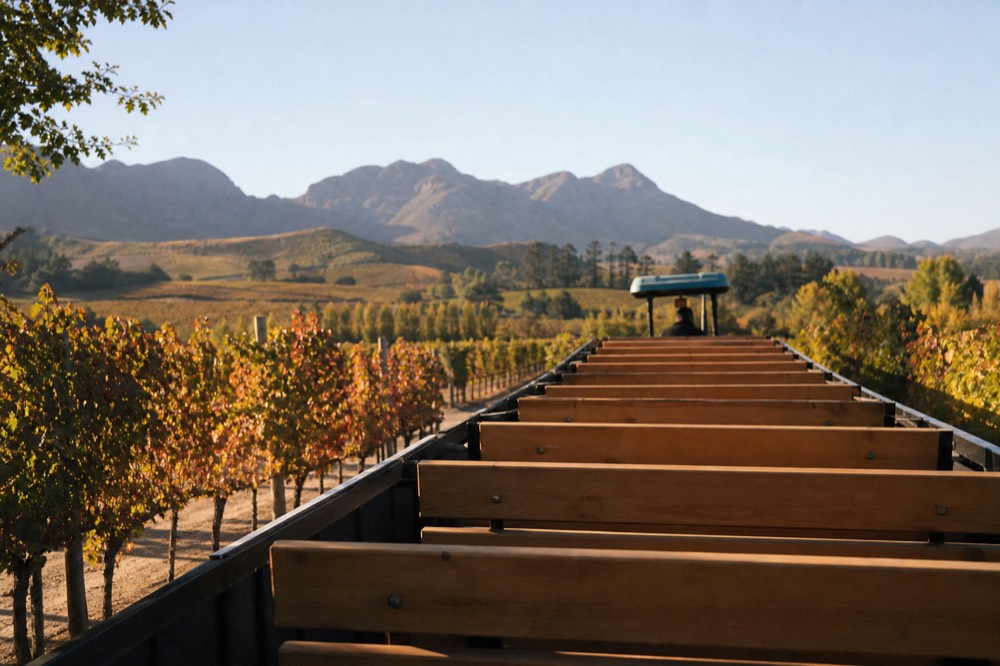
Stellenbosch's hop-on-hop-off options split by area. The wine tractor runs a compact loop of estates close together for easy on-off tasting. The Vine Hopper Northern Route covers the estates north of town toward the Simonsberg and Bottelary hills. The Eastern Route pass threads the estates toward the Helderberg and the eastern edge of the valley. Each loop is a cluster, so you stay in one part of the region rather than crossing it.
This clustering matters because Stellenbosch's farms are spread across valleys and hills, not strung along one road. A hop-on loop keeps you inside a single cluster where the estates sit minutes apart, which is exactly what makes the on-off format work. Cross-valley touring is where the fixed loops fall down, and where a guided day earns its keep. The map of how the farms cluster shows why each loop stays local, and which estates fall in which direction.
| Route | Area it covers | Character | Duration |
|---|---|---|---|
| Wine tractor loop | Estates close to town, tight cluster | Open-air, slow, easy on-off | Flexible, 3 to 10 h |
| Vine Hopper Northern | North of town, Simonsberg and Bottelary side | Classic reds, historic farms | About 8 h |
| Eastern Route | Toward the Helderberg and eastern valley | Big reds, valley drives | Flexible day pass |
| Vineyard wine walk | Private vineyards on foot | Time in the vines, not cellar-hopping | 3 to 4 h |
One honest caveat: the exact estates on any loop can shift with the season and the operator's arrangements, so treat a named farm as likely rather than promised. What the pass guarantees is the loop and the ride, not a specific cellar door. The Northern Route shuttle shows its fare on the day, so it is worth checking the northern loop format and you can check current dates and prices before you plan around it. If you want a particular estate for certain, a self-drive with a sober driver or a private route is the surer way, a point the private versus group comparison works through.
Is the Stellenbosch wine tractor worth it?
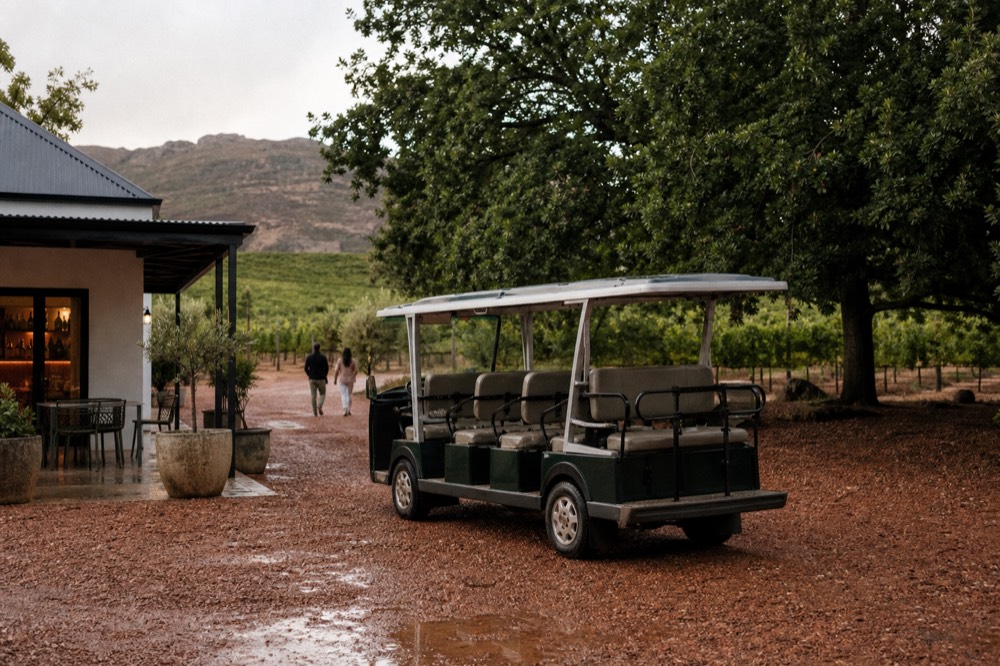
For an unhurried, self-paced day it is genuinely good value and a lot of fun, and the open-air ride between cellar doors is an experience in itself. It is worth it if you like setting your own rhythm and do not mind paying tasting fees on the day. It is poor value if you want a set itinerary, a guaranteed line-up of famous estates, or lunch and fees folded into one price.
The tractor rates 4.8 across 101 reviews, and the affection in that score is real: people enjoy the open trailer, the slow pace and the licence to linger. The verdict turns on temperament. If you want to wander, taste where you fancy and treat the fees as they come, the low seat price is a bargain and the day is yours. If you would rather hand over the planning, be driven to three strong estates and know the bill in advance, a guided full day is the better buy. Neither is wrong, and both beat the one option nobody should take, which is driving yourself between tastings.
That last point is not a throwaway. South Africa's drink-driving limit is 0.05 grams per 100 millilitres, and 0.02 for professional drivers, and a hop-on day is designed precisely so you never have to test it. A move toward a zero-tolerance limit was announced in January 2026 but is not yet law, so 0.05 stands, and the tractor exists so nobody in your group has to stay dry to drive.
What does a hop-on day really cost once you add tasting fees?
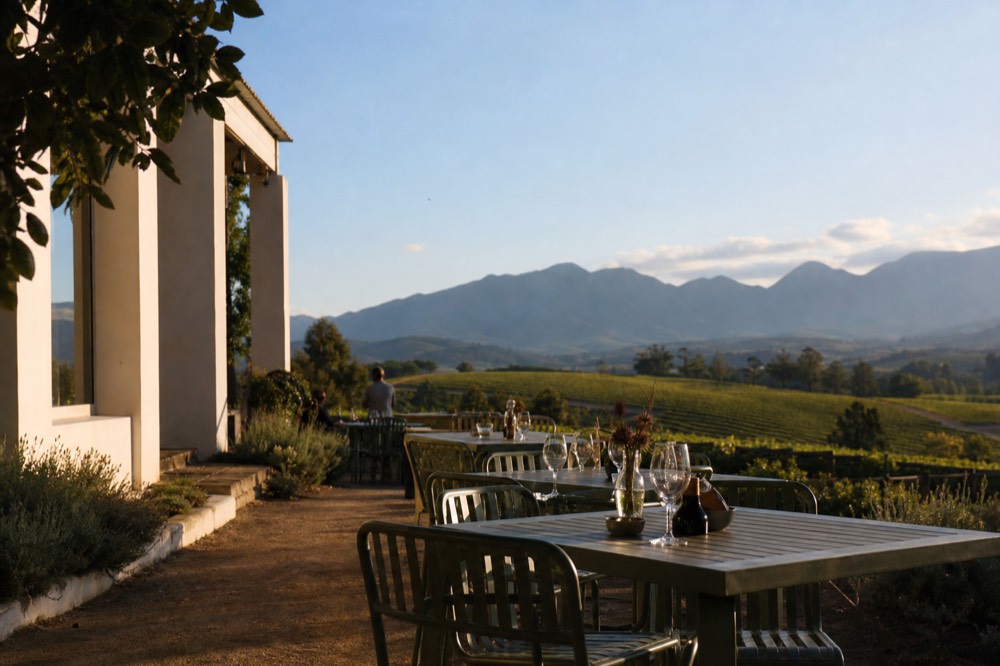
The seat is cheap, the day is not automatically. A tractor seat from $25 covers only the ride. Add a standard tasting at each of three or four farms, at R100 to R250 a stop, and the real spend for the day climbs to roughly R400 to R1,000 a person on top of the fare. Lunch and any premium flights push it higher. It is still often cheaper than a full guided day, but not by the margin the headline suggests.
This is the number the low sticker hides. A $25 seat looks unbeatable next to a $56 full day until you remember the full day usually includes the tastings and often lunch, while the tractor includes neither. Do the sum for a real day and the gap narrows sharply. The point is not that the tractor is bad value, it is that the seat price and the day's cost are two different things, and only one of them is on the listing.
| Cost line | Hop-on tractor day | Guided full day |
|---|---|---|
| The ride | Around $25 seat | Included in the price |
| Tastings, 3-4 farms | R100-250 each, paid on the day | Usually included |
| Lunch | Your own cost | Included on some full days |
| Planning | You choose stops and timing | Route set for you |
| Real day for one | Seat plus R400-1,000 in fees | From around $56, most bundled |
If you would rather the fees never appeared at all, the all-inclusive private and full-day formats fold every tasting into one price, and you can check current dates and prices on the tractor against the full-day circuit to see which suits your day and budget.
Who should book the tractor, and who should skip it?
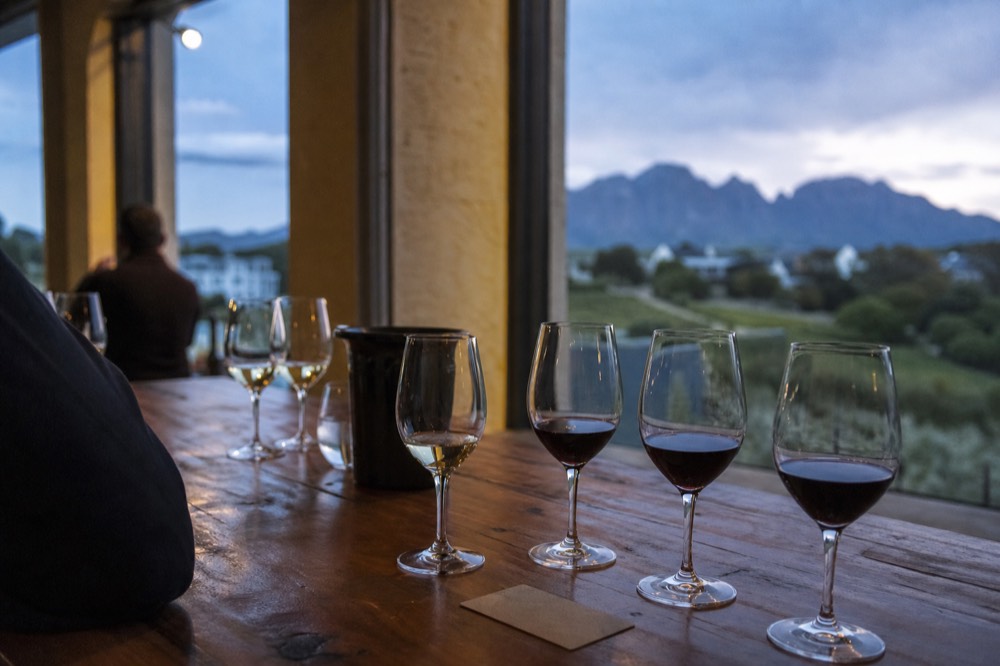
Book it if you want a relaxed, self-paced day, if you are happy to plan your own stops, or if the open-air ride appeals as much as the wine. Skip it if you want a guaranteed set of famous estates, a fixed schedule with lunch included, or a group that would rather be driven door to door without doing arithmetic at each counter. Larger groups and first-timers usually do better on a guided day.
The tractor rewards a certain kind of visitor and frustrates another. The self-directed traveller who likes to browse, linger and skip loves it. The planner who wants the day handed over, or the group juggling different tastes and paces, tends to find the on-off freedom becomes on-off logistics. The table sorts it cleanly.
| The tractor suits | Better on a guided day |
|---|---|
| Self-paced travellers who like to wander | Anyone wanting a fixed, planned itinerary |
| Budget-minded visitors happy to pay fees as they go | Those who want tastings and lunch bundled |
| Couples and small, easy-going groups | Larger groups with different tastes |
| A fine-weather day for the open trailer | A guaranteed line-up of named estates |
| People who enjoy the ride as an experience | First-timers who want the region curated |
For the visitor who wants the curated version, the three-region full day hands over the planning entirely, and for those weighing the town itself against the farms, whether you can walk around Stellenbosch answers the on-foot question the tractor half-raises.
How does it compare to a guided full-day tour?
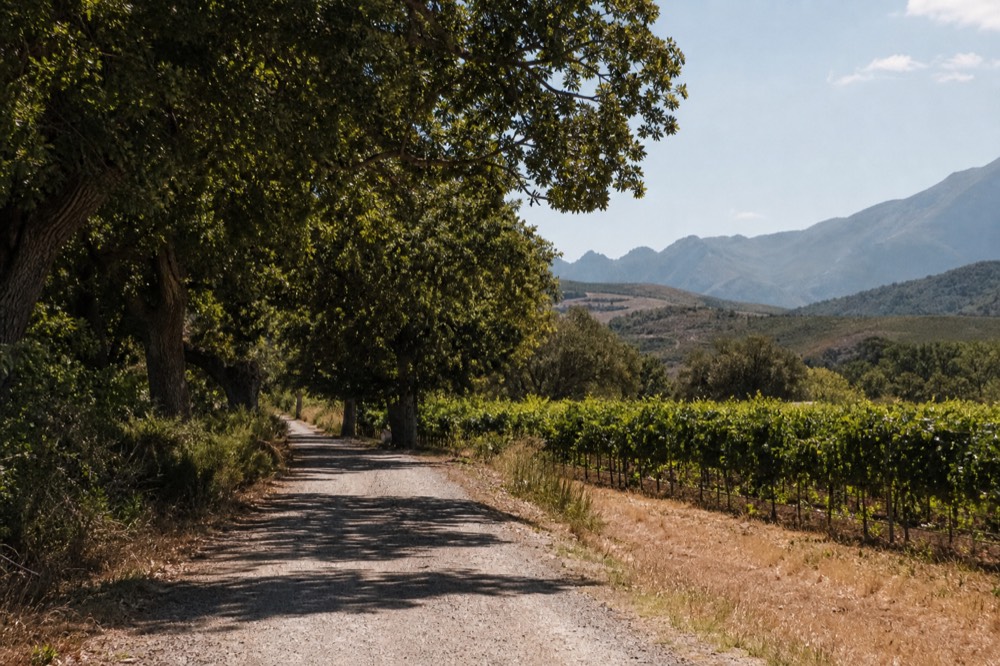
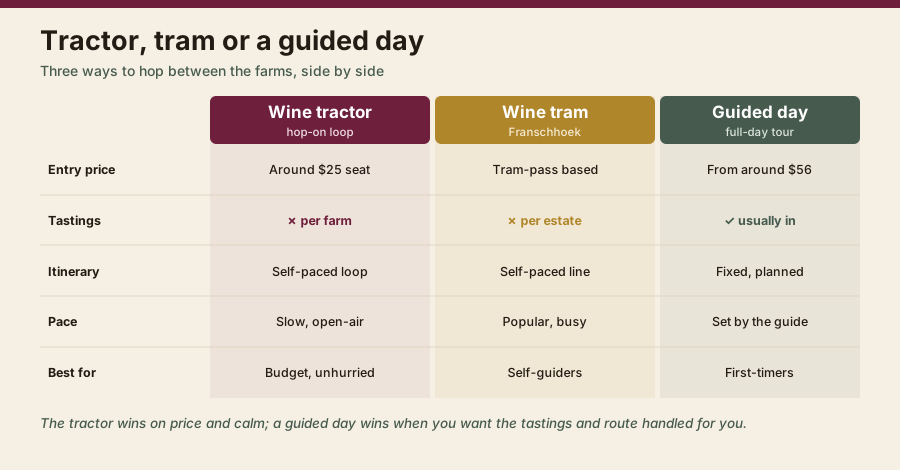
A guided full day costs more up front, from around $56, but includes the tastings, the route and usually lunch, with a driver-guide handling everything. The hop-on tractor is cheaper to board, at around $25, but you plan the day and pay fees at each farm. The tour buys certainty and ease, the tractor buys freedom and a lower entry price. Which wins depends on whether you value the plan or the flexibility more.
Set beside the Franschhoek tram, which is the product most people are actually comparing, the Stellenbosch tractor is cheaper and more rural in feel, while the tram is slicker, more famous and busier. The tram runs on rails and a road-tram combination through the Franschhoek valley; the tractor rolls farm tracks between Stellenbosch cellar doors. The Franschhoek tram's own route is the polished version of the same self-paced idea, and whether that tram is worth it is a fair question to ask alongside this one.
| Feature | Stellenbosch wine tractor | Franschhoek wine tram | Guided full-day tour |
|---|---|---|---|
| Entry price | Around $25 seat | Higher, tram-pass based | From around $56 |
| Tastings included | No, paid per farm | No, paid per estate | Usually yes |
| Itinerary | Self-paced loop | Self-paced along the line | Fixed, planned for you |
| Pace | Slow, open-air, rural | Popular, can be busy | Set by the guide |
| Best for | Unhurried budget days | Franschhoek self-guiders | First-timers wanting it curated |
What should you know before you go?
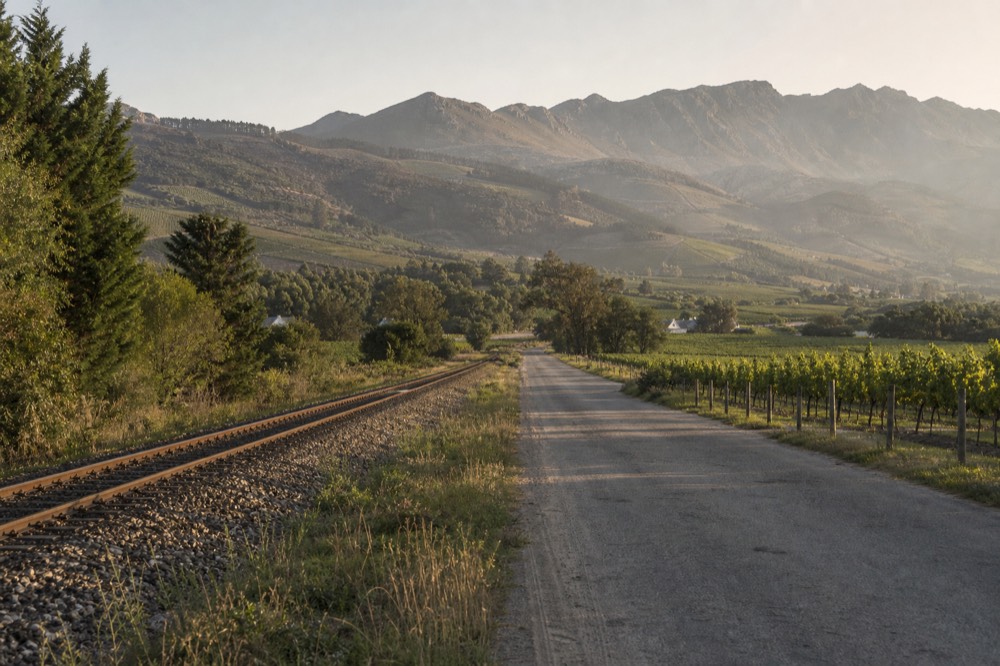
Pick a fine-weather day, because the tractor trailer is open to the sky. Start early to fit three or four stops before the last loop back. Carry cash or a card for tasting fees at each farm, and check the loop's timetable so you do not miss the final ride. Getting to Stellenbosch itself takes about 30 to 45 minutes from Cape Town by car or private transfer, longer by train.
A few practicals make or break a hop-on day. Weather first: the open trailer is glorious in sun and grim in rain, so watch the forecast. Timing second: the loops run to a schedule, and it is easy to over-linger at farm two and scramble for the last vehicle, so plan the return. Money third: each cellar door charges its own fee, so keep a card handy. And getting there is its own small decision, since the passes start in Stellenbosch rather than Cape Town.
| Getting to Stellenbosch | Time | Rough cost | Note |
|---|---|---|---|
| Private transfer from Cape Town | 30-45 min | From around $51 | Door to door, fixed price |
| Dedicated shuttle or coach | 25-55 min | Around $24-38 | Multiple daily services |
| Ride-hailing app | 30-45 min | Varies with surge | One option cheaper than the other on most routes |
| Metrorail train | Over 2 h | Low fare, cash | Daytime travel, common-sense care |
| Self-drive to town, then hop-on | 30-45 min | Car hire plus paid parking | Then no driving between farms |
Once you are in town, Stellenbosch rewards time on foot before or after the loop, with oak-lined streets, museums and tasting rooms in walking distance, all set out in the things to do in Stellenbosch guide and among the more unusual ways to spend a day here. For a full picture of arriving by car from the city, the Cape Town wine day guide covers the drive in detail.
How long do you need for a hop-on-hop-off day?
Plan on a full half-day at least, and a whole day to make the fare worthwhile. Three estates with a tasting at each, plus the loop time between them and a lunch stop, fills five to seven hours comfortably. The passes run flexibly, from about three hours to a full ten, so you set the length, but rushing three cellar doors into two hours defeats the point.
The hop-on format sells freedom, and the honest use of that freedom is time. A single stop and a taste can be done in a couple of hours, but the fare only earns its keep across several. A realistic day looks like a late-morning start, a first tasting, a loop to a second estate, lunch, then a third tasting before the last ride back, which lands between five and seven hours. Because you are not on a guide's clock, the temptation is to linger, and the risk is missing the final loop, so check the timetable and the last-vehicle time when you board. Weather sets a ceiling too, since the open trailer is a joy in sun and miserable in rain, so a fine forecast is worth waiting for. The slower you go, the fewer estates you fit, which is the format's honest tension: a self-paced day is a less-efficient day, and that is exactly why some people love it while others would rather be driven three estates in a planned line. If your group has a train or a transfer to catch back to Cape Town, work backward from that time and do not cut the last loop fine.
| If you have | Realistic stops | The feel of the day |
|---|---|---|
| 2 to 3 hours | One estate, one tasting | A taster, the fare barely earns out |
| 4 to 5 hours | Two estates, a light lunch | A relaxed half-day |
| 6 to 8 hours | Three estates and lunch | The fare's sweet spot |
| A full day | Three or four, unhurried | Maximum freedom, least efficient |
For visitors weaving the loop into a fuller itinerary, the single-day plan for Stellenbosch shows how a hop-on afternoon slots around a morning in town.
Common questions
Is there a wine tram in Stellenbosch?
No. The wine tram is Franschhoek's, one valley over. Stellenbosch's equivalent is the open wine tractor and a set of hop-on-hop-off shuttle loops that run the northern and eastern clusters of estates. They work on the same self-paced idea as the tram but cost less to board.
How much does the Stellenbosch wine tractor cost?
A seat starts around $25, which covers the ride only. Tasting fees are paid at each farm, usually R100 to R250 for a standard flight, so a real day of three or four stops adds roughly R400 to R1,000 a person on top of the fare. Lunch and premium flights cost more.
Is the wine tractor worth it?
For an unhurried, self-paced day it is good value and genuinely enjoyable, with the open-air ride part of the fun. It is worth it if you like planning your own stops and paying fees as you go. If you want a set itinerary with famous estates, lunch and fees included, a guided full day suits you better.
Do the hop-on-hop-off passes include tastings?
No, apart from the guided vineyard walk. The tractor and shuttle passes cover the transport, and you pay each estate's tasting fee at the counter. That keeps the seat price low and the day flexible, but means the real cost of the day is the fare plus a fee at every farm you choose to taste at.
Can you visit specific estates on the tractor route?
The loops cover a cluster of estates, but the exact farms can change with the season and the operator, so treat any named estate as likely rather than guaranteed. If a particular cellar door is a must, a private tour or a self-drive with a sober driver is the surer way to reach it.
How do you get to Stellenbosch for the tractor?
The passes start in Stellenbosch, about 30 to 45 minutes from Cape Town. A private transfer runs from around $51, dedicated shuttles from roughly $24 to $38, and the Metrorail train is cheap but takes over two hours. Once in town, the hop-on loops mean no driving between farms.